

Resource library

Evaluating Coding Agent Capabilities with Terminal-Bench: Snorkel’s Role in Building the Next Generation Benchmark

Closing the Evaluation Gap in Agentic AI
Announcing a $3M commitment to launch Open Benchmarks Grants

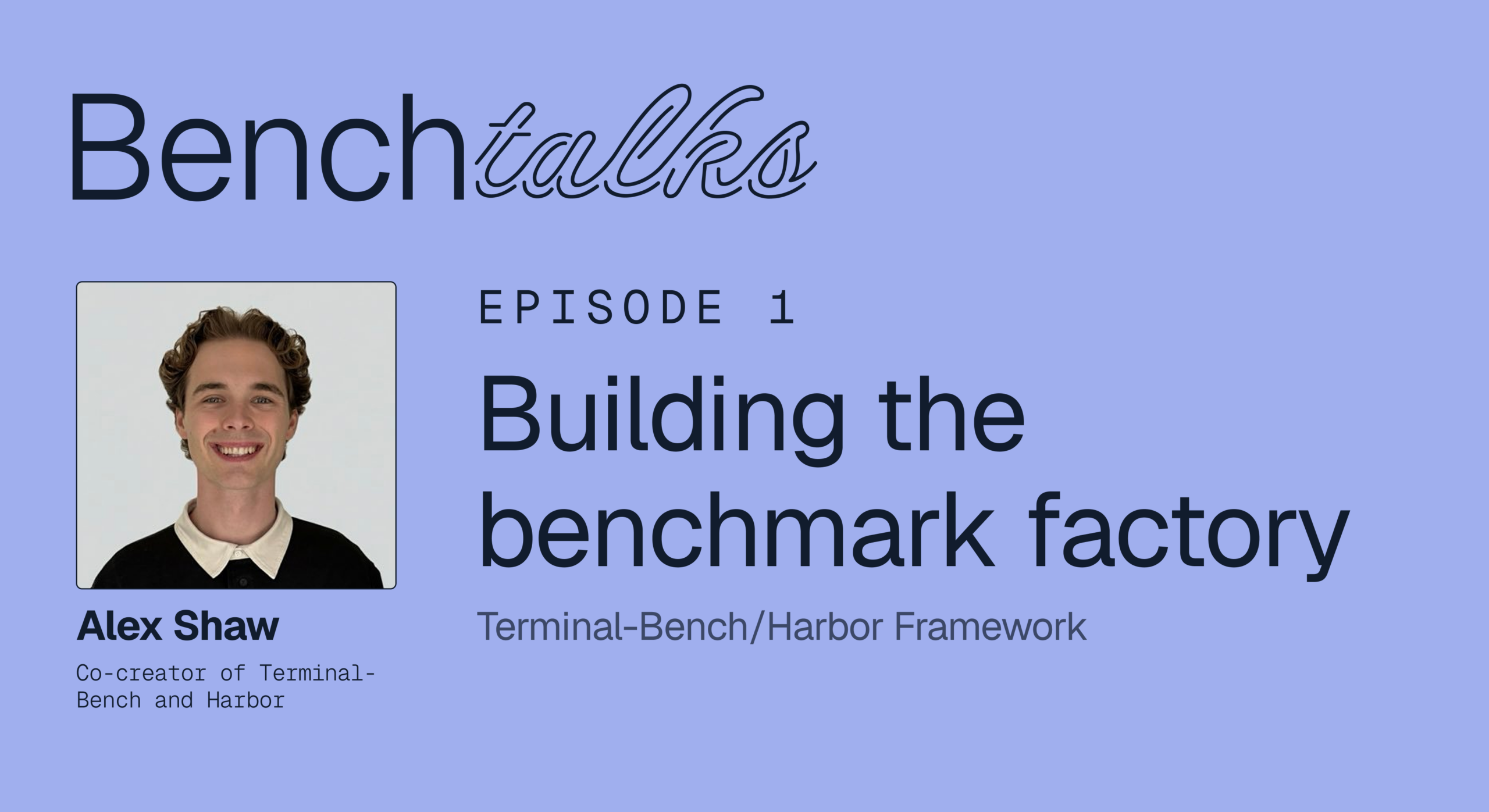
Benchtalks #1: Alex Shaw (Terminal-Bench, Harbor) – Building the Benchmark Factory
Building FinQA: An Open RL Environment for Financial Reasoning Agents



Objective: The change in performance of machine learning models over time as a result of temporal dataset shift is a barrier to machine learning-derived models facilitating decision-making in clinical practice. Our aim was to describe technical procedures used to preserve the performance of machine learning models in the presence of temporal dataset shifts. Methods: Studies were included if they were…

Complex biological, neuroscience, geoscience and social networks exhibit heterogeneous self-similar higher order topological structures that are usually characterized as being multifractal in nature. However, describing their topological complexity through a compact mathematical description and deciphering their topological governing rules has remained elusive and prevented a comprehensive understanding of networks. To overcome this challenge, we propose a weighted multifractal graph model…
Join the live discussion. Learn how to unlock data-centric AI and make AI development practical in your organization Working with vast unstructured and unlabeled data is one of the bottlenecks in the machine learning lifecycle. Machine learning models can only get as reliable and accurate as the data being fed to them. With a data-centric approach 1, your data science…
We started the Snorkel project at the Stanford AI lab in 2015 around two core hypotheses:
Machine Learning Whiteboard (MLW) Open-source Series Earlier this year, we started our machine learning whiteboard (MLW) series, an open-invite space to brainstorm ideas and discuss the latest papers, techniques, and workflows in the AI space. We emphasize an informal and open environment to everyone interested in learning about machine learning.In this episode, Manan Shah dives into “Glean: Structured Extractions from…
This work shows a rigorous technique for efficiently selecting small subsets of the labelers so that a majority vote from such subsets has a provably low error rate.
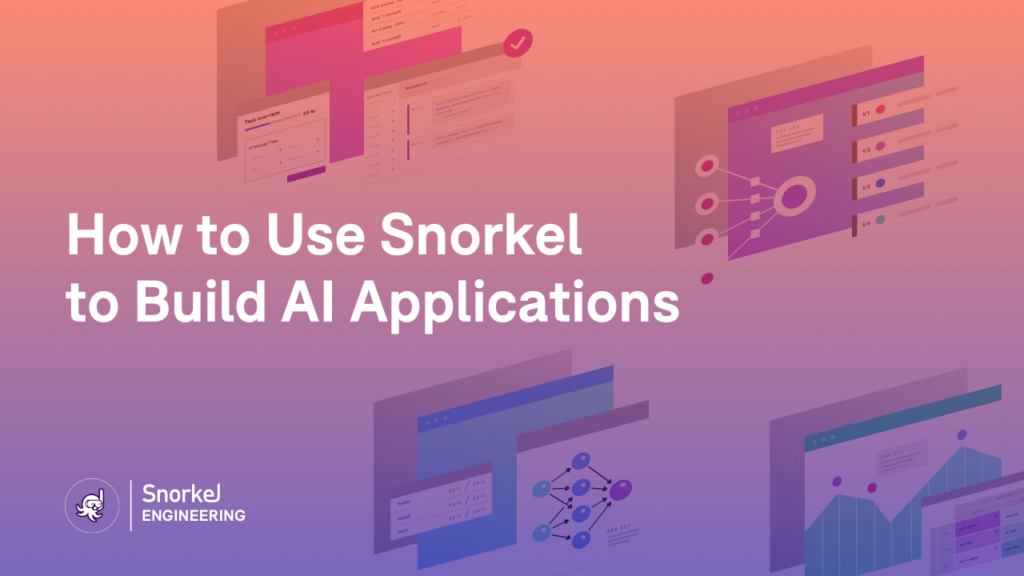
The how, what, and why of Snorkel’s programmatic data labeling approach and the state-of-the-art Snorkel Flow platform. The year was 2015. For the first time, machine learning (ML) had outperformed humans in the annual ImageNet challenge.

In this workshop, we want to advance theory, methods and tools for allowing experts to express prior coded knowledge for automatic data annotations that can be used to train arbitrary deep neural networks for prediction. The ICLR 2021 Workshop on Weak Supervision aims at advancing methods that help modern machine-learning methods to generalize from knowledge provided by experts, in interaction…

In many practical few-shot learning problems, even though labeled examples are scarce, there are abundant auxiliary datasets that potentially contain useful information. We propose the problem of extended few-shot learning to study these scenarios. We then introduce a framework to address the challenges of efficiently selecting and effectively using auxiliary data in few-shot image classification. Given a large auxiliary dataset…