

Resource library

Evaluating Coding Agent Capabilities with Terminal-Bench: Snorkel’s Role in Building the Next Generation Benchmark

Closing the Evaluation Gap in Agentic AI
Announcing a $3M commitment to launch Open Benchmarks Grants

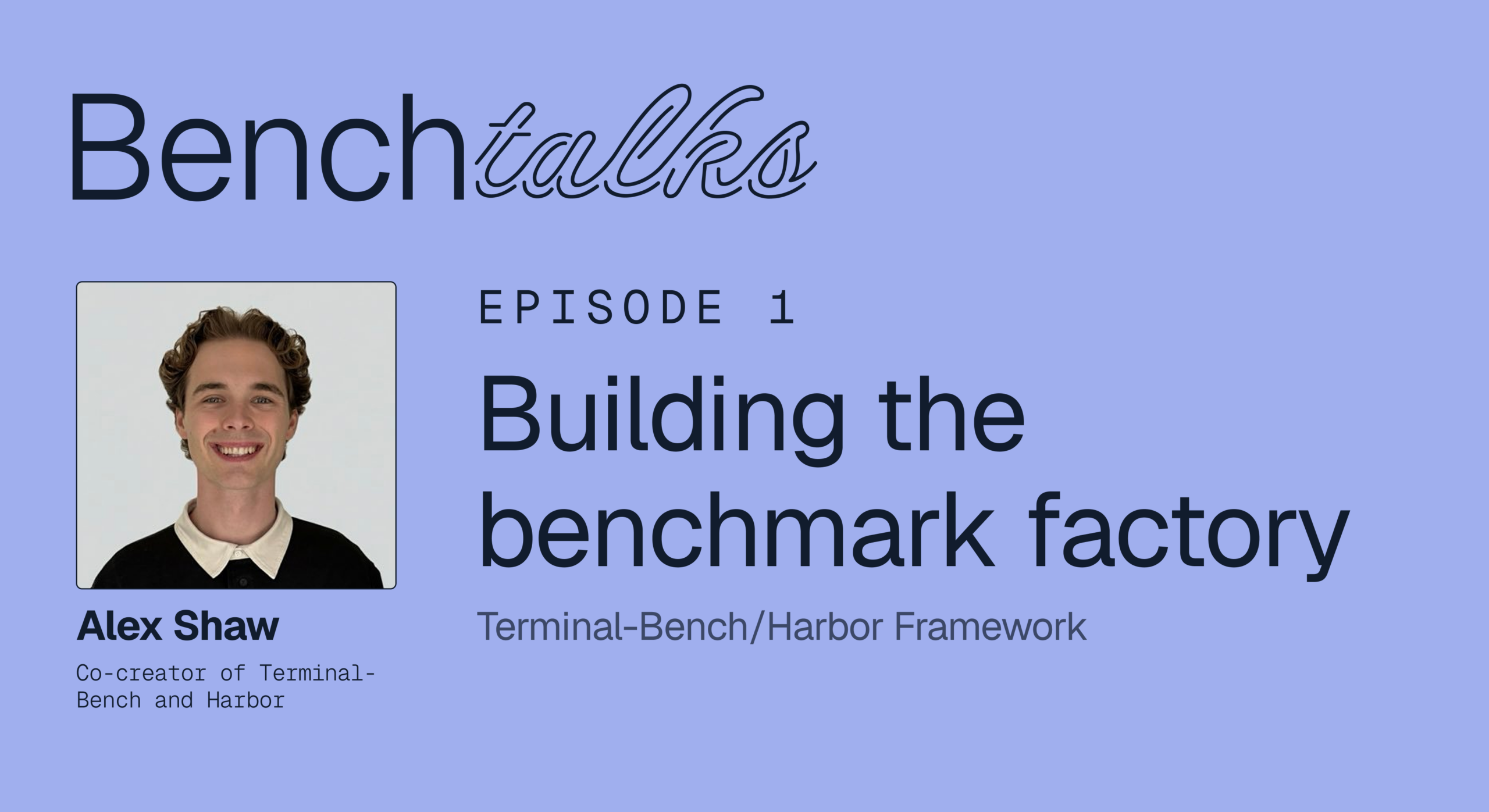
Benchtalks #1: Alex Shaw (Terminal-Bench, Harbor) – Building the Benchmark Factory
Building FinQA: An Open RL Environment for Financial Reasoning Agents


Machine Learning Whiteboard (MLW) Open-source Series We started our machine learning whiteboard (MLW) series earlier this year as an open-invite space to brainstorm ideas and discuss the latest papers, techniques, and workflows in the AI space. We emphasize an informal and open environment to everyone interested in learning about machine learning.In this episode, Fait Poms, a Ph.D. student at Stanford…
Main takeaways from The Future of Data-Centric AI Event We recently hosted The Future of Data-Centric AI, where academia, research, and industry experts and practitioners came together to discuss the shift from model-centric AI development to data-centric AI and what lies ahead. This post gives you a quick overview of the event and top takeaways from over eight hours of…

Many real-world ML deployments face the challenge of training a rare category model with a small labeling budget. In these settings, there is often access to large amounts of unlabeled data, therefore it is attractive to consider semisupervised or active learning approaches to reduce human labeling effort. However, prior approaches make two assumptions that do not often hold in practice;…
Defining and Building Malleable ML Systems – Machine Learning Whiteboard (MLW) Open-Source Series As you may know, earlier this year, we started our machine learning whiteboard (MLW) series, an open-invite space to brainstorm ideas and discuss the latest papers, techniques, and workflows in the AI space. We emphasize an informal and open environment to everyone interested in learning about machine learning. In this…
Frontend Development Best Practices for Working With Lots of Data From Snorkel AI Engineering As a frontend engineer, it’s often easy to run into limitations when scaling large applications. At Snorkel AI, we often run into times where our users work with data that scales into the gigabytes when using Snorkel Flow. We have built Snorkel Flow around two core…
Snorkel Flow LTS Release Summer ‘21 By adopting Snorkel Flow, a data-centric AI development platform powered by programmatic labeling, our customers have changed how they build and deploy AI applications. We’ve seen our customers save tens-of-millions of dollars in manual labeling costs and person-years of time by applying weak supervision with Snorkel Flow.Over the last few months, we’ve been hard…
ScienceTalks with Paroma Varma In this episode of Science Talks, Snorkel AI’s Braden Hancock chats with Paroma Varma – a co-founder of Snorkel AI and one of the first and leading contributors to the Snorkel project. We discuss Paroma’s path into machine learning, her work in optimization and signal processing during her undergrad, weak supervision and image data during her…
For machine learning models trained with limited labeled training data, validation stands to become the main bottleneck to reducing overall annotation costs. We propose a statistical validation algorithm that accurately estimates the F-score of binary classifiers for rare categories, where finding relevant examples to evaluate on is particularly challenging. Our key insight is that simultaneous calibration and importance sampling enables…
Diving Into SliceLine – Machine Learning Whiteboard (MLW) Open-source Series Earlier this year, we started our machine learning whiteboard (MLW) series, an open-invite space to brainstorm ideas and discuss the latest papers, techniques, and workflows in the AI space. We emphasize an informal and open environment to everyone interested in learning about machine learning.In this episode, Kaushik Shivakumar dives into…