

Diving Into SliceLine – Machine Learning Whiteboard (MLW) Open-source Series
Earlier this year, we started our machine learning whiteboard (MLW) series, an open-invite space to brainstorm ideas and discuss the latest papers, techniques, and workflows in the AI space. We emphasize an informal and open environment to everyone interested in learning about machine learning.In this episode, Kaushik Shivakumar dives into “SliceLine: Fast, Linear-Algebra-based Slice Finding for ML Model Debugging,” author by Svetlana Sagadeeva and Matthias Boehm, presented at SIGMOD 2021, receiving a Best Paper Award for Data Science.This episode is part of the #MLwhiteboard video series hosted by Snorkel AI. Check out the episode here:
Abstract:
Slice finding—a recent work on debugging machine learning (ML) models—aims to find the top-K data slices (e.g., conjunctions of predicates such as gender female and degree Ph.D.), where a trained model performs significantly worse than on the entire training/test data. These slices may be used to acquire more data for the problematic subset, add rules, or otherwise improve the model. In contrast to decision trees, the general slice finding problem allows for overlapping slices. The resulting search space is huge as it covers all subsets of features and their distinct values. Hence, existing work primarily relies on heuristics and focuses on small datasets that fit in the memory of a single node. In this paper, we address these scalability limitations of slice finding in a holistic manner from both algorithmic and system perspectives. We leverage monotonicity properties of slice sizes, errors, and resulting scores to facilitate effective pruning. Additionally, we present an elegant linear-algebra-based enumeration algorithm, which allows for fast enumeration and automatic parallelization on top of existing ML systems. Experiments with different real-world regression and classification datasets show that effective pruning and efficient sparse linear algebra renders exact enumeration feasible, even for datasets with many features, correlations, and data sizes beyond single node memory.
If you are interested in learning with us, consider joining us at our biweekly ML whiteboard.If you’re interested in staying in touch with Snorkel AI, follow us on Twitter, LinkedIn, Facebook, Youtube, or Instagram, and if you’re interested in joining the Snorkel team, we’re hiring! Please apply on our careers page.

Recommended articles
View all articles
Grok 4.7 on Senior SWE-Bench: Strong pass@3, Cheaper Cost per Trial
Grok 4.7 was evaluated on Senior SWE-Bench, our benchmark for measuring whether coding agents work like senior engineers. It reaches a tasteful pass@3 of 40.0%, up from 38.9% for Grok 4.6, ranking sixth overall at $0.24 per trial, which is a fraction of the cost compared to Opus 4.8. Benchmark Senior SWE-Bench evaluates agents as compared to a senior engineer.
September 21, 2026
•
Snorkel Team
Data 2.0 and the research era of AI data
Today, I’m excited to announce Snorkel’s $350M Series E financing at a $3.5B valuation, led by Insight and S32, with participation from Third Point, March, Blumberg, Allegis, Standard VC, Frontline, and existing investors Addition, Lightspeed, Greylock, GV, P7, Wells Fargo, Walden Catalyst Ventures, and Factory.
September 20, 2026
•
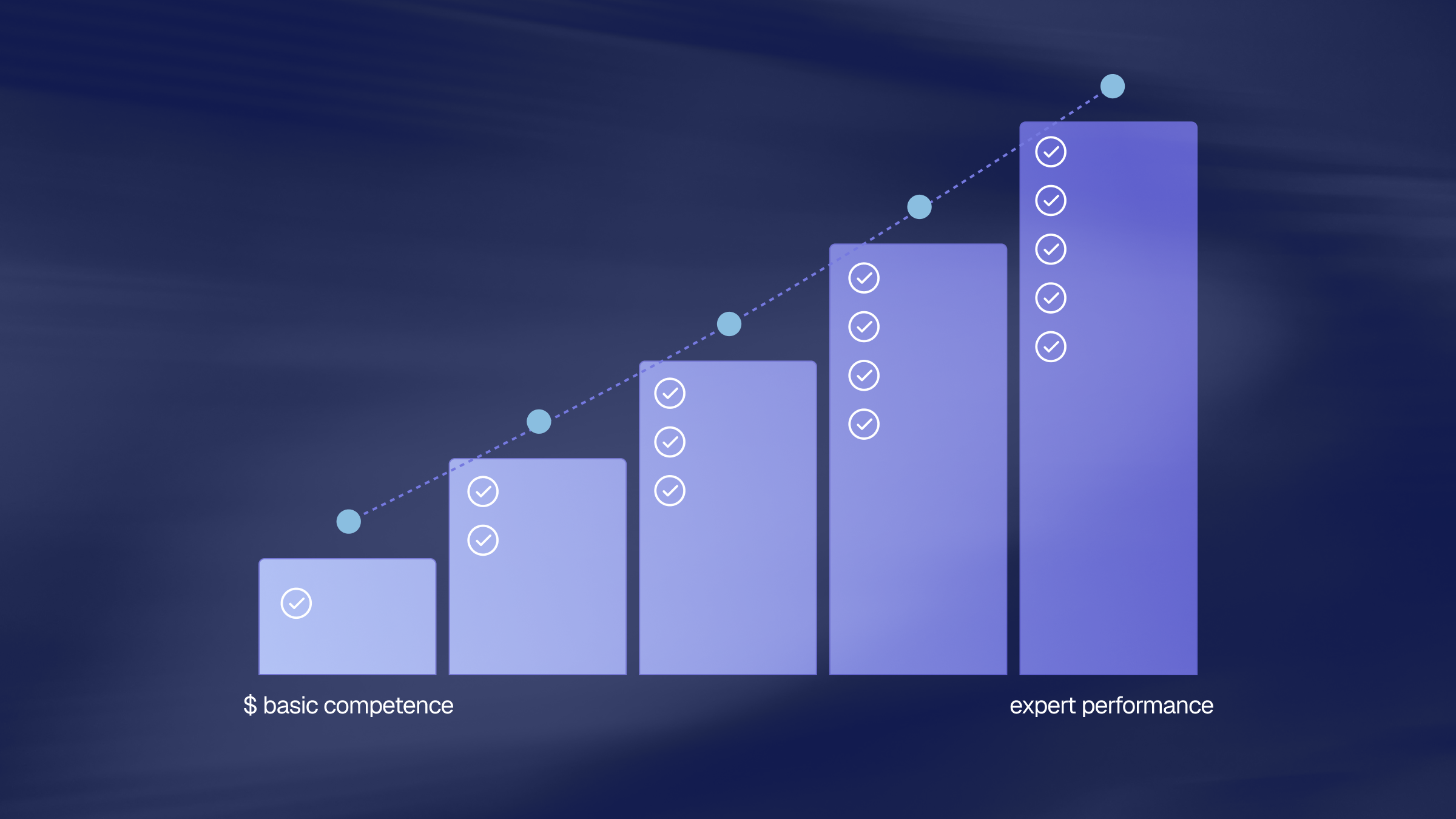
From Foundational Competency to Expert Performance: A Curriculum Approach to Model Development
A student does not go from 1st to 12th grade in a single step. Each grade builds on a specific set of skills, and each one assumes the previous skills have already been mastered. Nobody learns calculus without algebra. When a student skips ahead anyway, what they end up with is memorization rather than understanding. The gaps show up later,
September 15, 2026
•
Snorkel Team