

Resource library

Evaluating Coding Agent Capabilities with Terminal-Bench: Snorkel’s Role in Building the Next Generation Benchmark

Closing the Evaluation Gap in Agentic AI
Announcing a $3M commitment to launch Open Benchmarks Grants

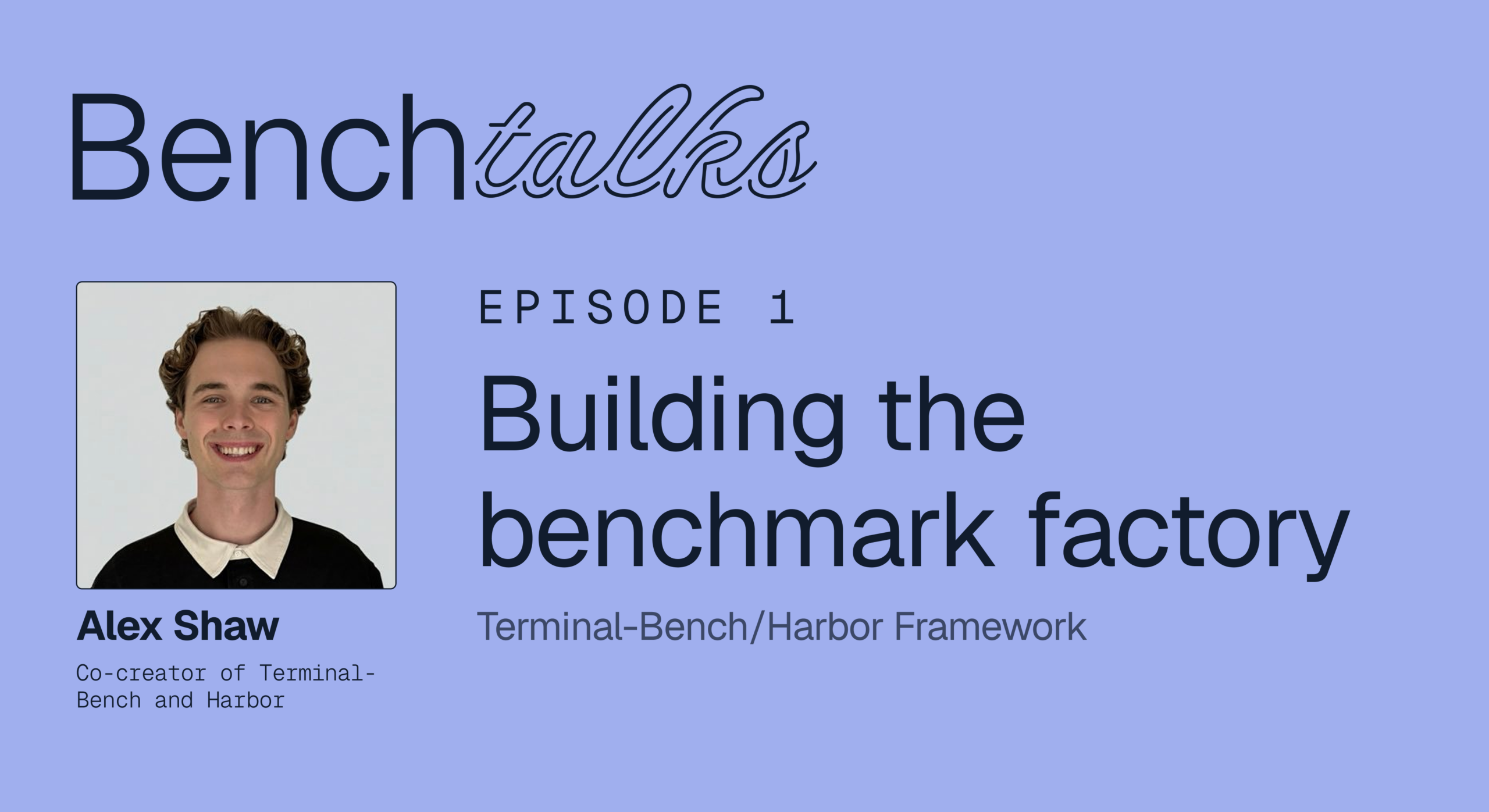
Benchtalks #1: Alex Shaw (Terminal-Bench, Harbor) – Building the Benchmark Factory
Building FinQA: An Open RL Environment for Financial Reasoning Agents



Machine learning models are often deployed in different settings than they were trained and validated on, posing a challenge to practitioners who wish to predict how well the deployed model will perform on a target distribution. If an unlabeled sample from the target distribution is available, along with a labeled sample from a possibly different source distribution, standard approaches such…
Machine Learning Whiteboard (MLW) Open-source Series Our machine learning whiteboard (MLW) is an open-invite space to brainstorm ideas and discuss the latest papers, techniques, and workflows in the AI space. We emphasize an informal and open environment to everyone interested in discovering more about machine learning.In this episode, Hiromu Hota, Vincent Sunn Chen, Daniel Y. Fu, and Frederic Sala dive…

In situations where explanations of black-box models may be useful, the fairness of the blackbox is also often a relevant concern. However, the link between the fairness of the black-box model and the behavior of explanations for the black-box is unclear. We focus on explanations applied to tabular datasets, suggesting that explanations do not necessarily preserve the fairness properties of…
In this episode of Science Talks, Snorkel AI’s Braden Hancock chats with Jason Fries – a research scientist at Stanford University’s Biomedical Informatics Research lab and Snorkel Research, and one of the first contributors to the Snorkel open-source library. We discuss Jason’s path into machine learning, empowering doctors and scientists with weak supervision, and utilizing organizational resources in biomedical applications of Snorkel. This episode is part…

The human ability to solve complex manipulation tasks is based on a flexible generalizable understanding of intuitive physics mostly learned through curiosity-driven self-play during infancy. We aim to replicate such interactive learning in artificial agents to achieve the same flexibility and generalizability when solving complex manipulation tasks. For that purpose, we introduce a general framework for learning intuitive physics through…
Machine Learning Whiteboard (MLW) Open-source Series Earlier this year, we started our machine learning whiteboard (MLW) series, an open-invite space to brainstorm ideas and discuss the latest papers, techniques, and workflows in the AI space. We emphasize an informal and open environment to everyone interested in learning about machine learning.In this episode, our Co-founder and Head of Technology. Braden Hancock…
In this episode of Science Talks, Frederic Sala – an assistant professor of Computer Science at the University of Wisconsin Madison and a research scientist at Snorkel discusses his path into machine learning, the central thesis that ties together his multidisciplinary research, his thoughts on the future of weak supervision, as well as his decision to go into academia.
This paper presents a rigorous approach for using a set of arbitrarily correlated weak supervision sources in order to solve a multiclass classification task when only a very small set of labeled data is available
Impractical ML assumptions are made every day in research, which limit its adoption. In the real world, these assumptions do not hold up. Learn more about how to avoid making these assumptions about AI application development.