

resources

Resource library

Explore our complete library of resources including blogs, benchmarks, research papers and more.
Image for Evaluating Coding Agent Capabilities with Terminal-Bench: Snorkel’s Role in Building the Next Generation Benchmark
Blog

Evaluating Coding Agent Capabilities with Terminal-Bench: Snorkel’s Role in Building the Next Generation Benchmark

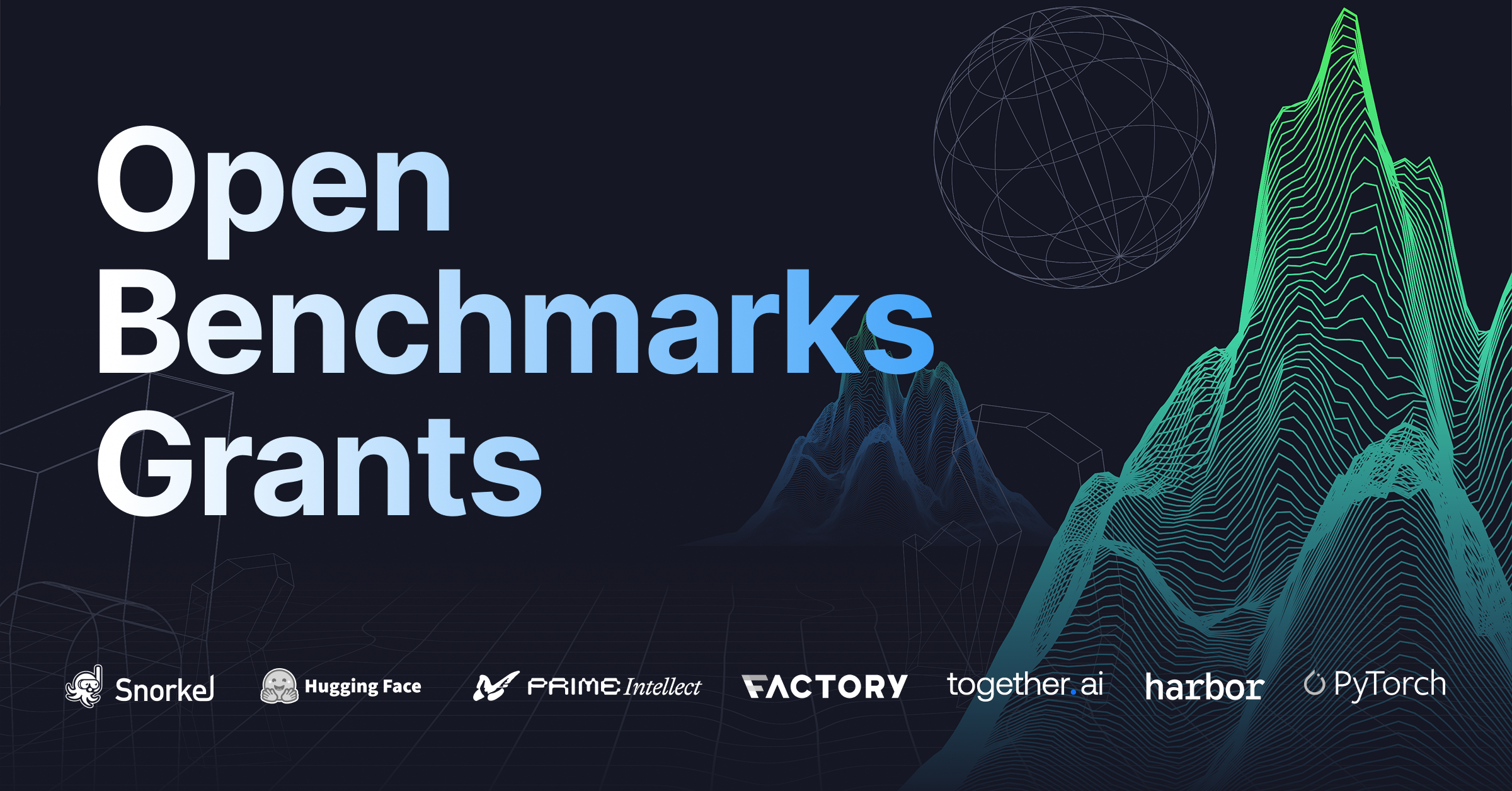
Announcing a $3M commitment to launch Open Benchmarks Grants
September 30, 2025
Image for Closing the Evaluation Gap in Agentic AI
Blog

Closing the Evaluation Gap in Agentic AI

Announcing a $3M commitment to launch Open Benchmarks Grants

February 11, 2026
Image for Benchtalks #1: Alex Shaw (Terminal-Bench, Harbor) – Building the Benchmark Factory
Blog

Benchtalks #1: Alex Shaw (Terminal-Bench, Harbor) – Building the Benchmark Factory

Announcing a $3M commitment to launch Open Benchmarks Grants

March 31, 2026
Image for Building FinQA: An Open RL Environment for Financial Reasoning Agents
Blog

Building FinQA: An Open RL Environment for Financial Reasoning Agents

Announcing a $3M commitment to launch Open Benchmarks Grants
March 30, 2026
Image for The science of rubric design
Blog

The science of rubric design

Announcing a $3M commitment to launch Open Benchmarks Grants
September 11, 2025
of
Type: All Types
Sort: Newest
Cut out the annotator, keep the cutout: better segmentation with weak supervision
Constructing large, labeled training datasets for segmentation models is an expensive and labor-intensive process. This is a common challenge in machine learning, addressed by methods that require few or no labeled data points such as few-shot learning (FSL) and weakly-supervised learning (WS). Such techniques, however, have limitations when applied to image segmentation—FSL methods often produce noisy results and are strongly dependent on which few datapoints are labeled, while WS models struggle to fully exploit rich image information. We propose a framework that fuses FSL and WS for segmentation tasks, enabling users to train high-performing segmentation networks with very few hand-labeled...
Research Paper
Cut out the annotator, keep the cutout: better segmentation with weak supervision

Constructing large, labeled training datasets for segmentation models is an expensive and labor-intensive process. This is a common challenge in machine learning, addressed by methods that require few or no labeled data points such as few-shot learning (FSL) and weakly-supervised learning (WS). Such techniques, however, have limitations when applied to image segmentation—FSL methods often produce noisy results and are strongly…

Jan 12, 2021

S. Hooper, et al.

Learn more about Cut out the annotator, keep the cutout: better segmentation with weak supervision
How To Overcome Practical Challenges for AI in the Public Sector
Blog
How To Overcome Practical Challenges for AI in the Public Sector

AI is already transforming the business of government. But the positive impacts of this transformation, from increasing the efficiency of public services to enhancing the effectiveness of tax dollars, are still in the earliest stages. Public sector organizations generally have access to the same talent, software models, and hardware infrastructure as any private sector company, but they face a number of relatively unique practical challenges that hinder their operationalization of AI.

Jan 07, 2021
Learn more about How To Overcome Practical Challenges for AI in the Public Sector
Background Splitting: Finding Rare Classes in a Sea of Background
We focus on the problem of training deep image classification models for a small number of extremely rare categories. In this common, real-world scenario, almost all images belong to the background category in the dataset. We find that state-of-the-art approaches for training on imbalanced datasets do not produce accurate deep models in this regime. Our solution is to split the large, visually diverse background into many smaller, visually similar categories during training. We implement this idea by extending an image classification model with an additional auxiliary loss that learns to mimic the predictions of a pre-existing classification model on the...
Research Paper
Background Splitting: Finding Rare Classes in a Sea of Background

We focus on the problem of training deep image classification models for a small number of extremely rare categories. In this common, real-world scenario, almost all images belong to the background category in the dataset. We find that state-of-the-art approaches for training on imbalanced datasets do not produce accurate deep models in this regime. Our solution is to split the…

Jan 01, 2021

RT. Mullapudi, et al.

Learn more about Background Splitting: Finding Rare Classes in a Sea of Background
Language models are an effective representation learning technique for electronic health record data
Widespread adoption of electronic health records (EHRs) has fueled the development of using machine learning to build prediction models for various clinical outcomes. However, this process is often constrained by having a relatively small number of patient records for training the model. We demonstrate that using patient representation schemes inspired from techniques in natural language processing can increase the accuracy of clinical prediction models by transferring information learned from the entire patient population to the task of training a specific model, where only a subset of the population is relevant. Such patient representation schemes enable a 3.5% mean improvement in...
Research Paper
Language models are an effective representation learning technique for electronic health record data

Widespread adoption of electronic health records (EHRs) has fueled the development of using machine learning to build prediction models for various clinical outcomes. However, this process is often constrained by having a relatively small number of patient records for training the model. We demonstrate that using patient representation schemes inspired from techniques in natural language processing can increase the accuracy…

Jan 01, 2021

E. Steinberg, et al.

Learn more about Language models are an effective representation learning technique for electronic health record data
Blog
How To Overcome Practical Challenges for AI in Finance

Advancements in artificial intelligence promise efficiency gains for financial institutions. AI-powered applications can revolutionize an organization’s risk management, fraud detection, compliance monitoring, and other processes. Financial services companies have smart data scientists and good infrastructure needed for deploying AI. But their ability to rapidly develop and deploy AI applications is hampered by several unique challenges.

Dec 29, 2020
Learn more about How To Overcome Practical Challenges for AI in Finance
Blog
Machine Learning Production Myths

Takeaways from MLSys Seminars with Chip HuyenIn November, I had the opportunity to come back to Stanford to participate in MLSys Seminars, a series about Machine Learning Systems. It was great to see the growing interest of the academic community in building practical AI applications. Here is a recording of the talk.The talk was originally about the principles of good…

Dec 23, 2020
Learn more about Machine Learning Production Myths
Leveraging Organizational Resources to Adapt Models to New Data Modalities
This work demonstrates how organizational resources, in the form of aggregate statistics, knowledge bases, and existing services can be used to connect new and existing data modalities.
Research Paper
Leveraging Organizational Resources to Adapt Models to New Data Modalities

This work demonstrates how organizational resources, in the form of aggregate statistics, knowledge bases, and existing services can be used to connect new and existing data modalities.

Nov 23, 2020

S. Suri, et al, 2020

Learn more about Leveraging Organizational Resources to Adapt Models to New Data Modalities
Parameterizing neural power spectra into periodic and aperiodic components
Electrophysiological signals exhibit both periodic and aperiodic properties. Periodic oscillations have been linked to numerous physiological, cognitive, behavioral and disease states. Emerging evidence demonstrates that the aperiodic component has putative physiological interpretations and that it dynamically changes with age, task demands and cognitive states. Electrophysiological neural activity is typically analyzed using canonically defined frequency bands, without consideration of the aperiodic (1/f-like) component. We show that standard analytic approaches can conflate periodic parameters (center frequency, power, bandwidth) with aperiodic ones (offset, exponent), compromising physiological interpretations. To overcome these limitations, we introduce an algorithm to parameterize neural power spectra as a combination...
Research Paper
Parameterizing neural power spectra into periodic and aperiodic components

Electrophysiological signals exhibit both periodic and aperiodic properties. Periodic oscillations have been linked to numerous physiological, cognitive, behavioral and disease states. Emerging evidence demonstrates that the aperiodic component has putative physiological interpretations and that it dynamically changes with age, task demands and cognitive states. Electrophysiological neural activity is typically analyzed using canonically defined frequency bands, without consideration of the aperiodic…

Nov 23, 2020

T. Donoghue, et al.

Learn more about Parameterizing neural power spectra into periodic and aperiodic components
Fast and Three-Rious: Speed up Weak Supervision With Triplet Methods
Introducing FlyingSquid, a weak supervision framework that runs orders of magnitude faster than previous weak supervision approaches and requires fewer assumptions
Research Paper
Fast and Three-Rious: Speed up Weak Supervision With Triplet Methods

Introducing FlyingSquid, a weak supervision framework that runs orders of magnitude faster than previous weak supervision approaches and requires fewer assumptions

Nov 20, 2020

D. Fu, et al, 2020

Learn more about Fast and Three-Rious: Speed up Weak Supervision With Triplet Methods
1 57 58 59 64
Image
Image

Join our newsletter

For expert advice, the latest research, and exclusive events.
By submitting this form, I acknowledge I will receive email updates from Snorkel AI, and I agree to the Terms of Use and acknowledge that my information will be used in accordance with the Privacy Policy.