
resources

Resource library

Explore our complete library of resources including blogs, benchmarks, research papers and more.
Image for Evaluating Coding Agent Capabilities with Terminal-Bench: Snorkel’s Role in Building the Next Generation Benchmark
Blog

Evaluating Coding Agent Capabilities with Terminal-Bench: Snorkel’s Role in Building the Next Generation Benchmark

Announcing a $3M commitment to launch Open Benchmarks Grants
September 30, 2025
Image for Closing the Evaluation Gap in Agentic AI
Blog

Closing the Evaluation Gap in Agentic AI

Announcing a $3M commitment to launch Open Benchmarks Grants

February 11, 2026
Image for Benchtalks #1: Alex Shaw (Terminal-Bench, Harbor) – Building the Benchmark Factory
Blog

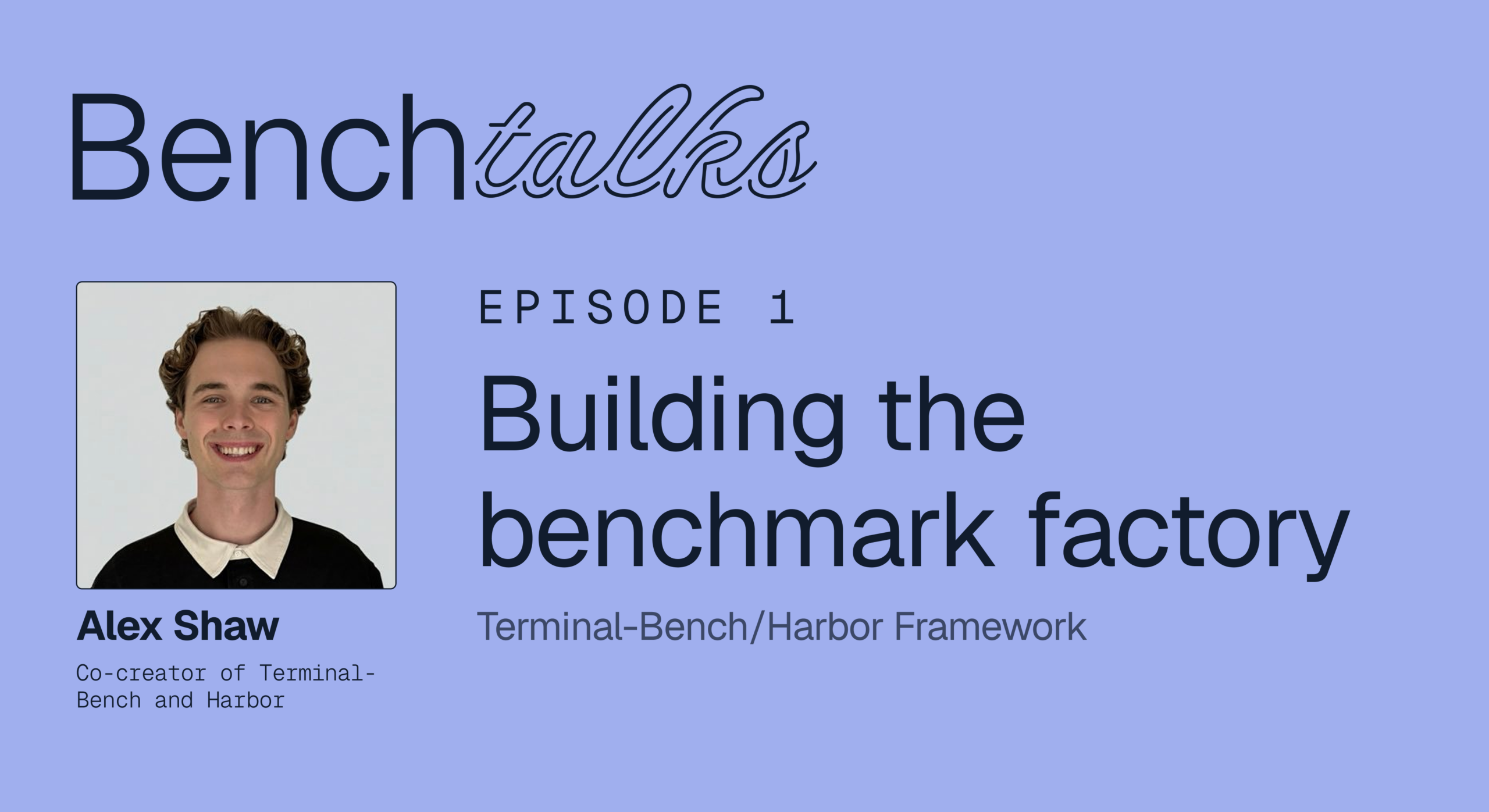
Benchtalks #1: Alex Shaw (Terminal-Bench, Harbor) – Building the Benchmark Factory

Announcing a $3M commitment to launch Open Benchmarks Grants
March 31, 2026
Image for Building FinQA: An Open RL Environment for Financial Reasoning Agents
Blog

Building FinQA: An Open RL Environment for Financial Reasoning Agents

Announcing a $3M commitment to launch Open Benchmarks Grants
March 30, 2026
Image for The science of rubric design
Blog

The science of rubric design

Announcing a $3M commitment to launch Open Benchmarks Grants
September 11, 2025
of
Type: All Types
Sort: Newest
Parsing Isn’t Neutral: Why Evaluation Choices Matter
Blog
Parsing Isn’t Neutral: Why Evaluation Choices Matter

Behind every AI benchmark is a hidden choice: how to read the model’s answers. That choice—parsing—can quietly tilt results more than the model itself. Parsing is where we take an AI system’s raw response and extract the “answer” we use for scoring. It sounds mechanical, but as our research shows, the choice of parser can dramatically change measured accuracy. In…

Sep 26, 2025
Learn more about Parsing Isn’t Neutral: Why Evaluation Choices Matter
The science of rubric design
Blog
The science of rubric design

Part 3 of our rubric series explains the science of rubric design. We show why rubrics should be treated like models—structured, measured, and iterated—to maximize objective alignment and inter-rater agreement. Learn how to choose hierarchy and scale points, track agreement (IAA) and LLMAJ alignment, and refine with domain experts, with examples like PaperBench and HealthBench.

Sep 11, 2025
Learn more about The science of rubric design
The right tool for the job: An A-Z of rubrics
Blog
The right tool for the job: An A-Z of rubrics

Rubrics turn fuzzy “good vs. bad” into measurable criteria for GenAI. In Part 2, we map what to measure (granularity and dataset-level vs instance-specific), where to measure (process vs outcome), and how to measure (humans, LLM-as-judge, code, reward models)—with examples like HHH, FLASK, HealthBench, and PaperBench.

Sep 02, 2025
Learn more about The right tool for the job: An A-Z of rubrics
How a leading international telecom provider scaled agentic AI with high-quality synthetic data
Case study
How a leading international telecom provider scaled agentic AI with high-quality synthetic data

Customer Story An Asian telecom leader aimed to expand its offerings with a flagship AI personal assistant. However, the team faced critical roadblocks:  These gaps made it challenging to iterate quickly, inflating development costs and stalling deployment The company partnered with Snorkel AI to radically improve how it created and evaluated data for agentic systems to overcome these issues. In…

Aug 19, 2025
Snorkel Team
Learn more about How a leading international telecom provider scaled agentic AI with high-quality synthetic data
Shrinking the Generation-Verification Gap with Weak Verifiers
Verifiers can enhance language model (LM) performance by scoring and ranking a set of generated responses, but high-quality verifiers today are either unscalable (like human judges) or of limited practical use (such as formal proof tools like Lean). While LM-based judges and reward models serve as general-purpose verifiers, they still fall short of the performance levels achieved by oracle verifiers, which are perfectly accurate. To bridge this gap, the Weaver framework is introduced as a method for constructing a strong verifier by combining multiple weaker, imperfect ones. Weaver shows that weighted ensembles of verifiers, which traditionally depend on labeled data,...
Research Paper
Shrinking the Generation-Verification Gap with Weak Verifiers

Verifiers can enhance language model (LM) performance by scoring and ranking a set of generated responses, but high-quality verifiers today are either unscalable (like human judges) or of limited practical use (such as formal proof tools like Lean). While LM-based judges and reward models serve as general-purpose verifiers, they still fall short of the performance levels achieved by oracle verifiers,…

Jul 30, 2025

Jon Saad-Falcon, et all.

Learn more about Shrinking the Generation-Verification Gap with Weak Verifiers
Data quality and rubrics: how to build trust in your models
Blog
Data quality and rubrics: how to build trust in your models

Rubrics aren’t just for evaluation—they’re a blueprint for better data annotation. In this post, we explore how structured rubrics enable scalable, high-quality labeling and evaluation of GenAI systems. Learn how Snorkel and leading labs use rubrics to align human and automated judgment and accelerate trusted AI development.

Jul 29, 2025
Learn more about Data quality and rubrics: how to build trust in your models
Building the Benchmark: Inside Our Agentic Insurance Underwriting Dataset
Blog
Building the Benchmark: Inside Our Agentic Insurance Underwriting Dataset

In this post, we unpack how Snorkel built a realistic benchmark dataset to evaluate AI agents in commercial insurance underwriting. From expert-driven data design to multi-tool reasoning tasks, see how our approach surfaces actionable failure modes that generic benchmarks miss—revealing what it really takes to deploy AI in enterprise workflows.

Jul 10, 2025
Learn more about Building the Benchmark: Inside Our Agentic Insurance Underwriting Dataset
Evaluating AI Agents for Insurance Underwriting
Blog
Evaluating AI Agents for Insurance Underwriting

In this post, we will show you a specialized benchmark dataset we developed with our expert network of Chartered Property and Casualty Underwriters (CPCUs). The benchmark uncovers several model-specific and actionable error modes, including basic tool use errors and a surprising number of insidious hallucinations from one provider. This is part of an ongoing series of benchmarks we are releasing across verticals…

Jun 26, 2025
Learn more about Evaluating AI Agents for Insurance Underwriting
Blog
LLM Observability: Key Practices, Tools, and Challenges

LLM observability is crucial for monitoring, debugging, and improving large language models. Learn key practices, tools, and strategies of LLM observability.

Jun 23, 2025
Learn more about LLM Observability: Key Practices, Tools, and Challenges
1 4 5 6 64
Image
Image

Join our newsletter

For expert advice, the latest research, and exclusive events.
By submitting this form, I acknowledge I will receive email updates from Snorkel AI, and I agree to the Terms of Use and acknowledge that my information will be used in accordance with the Privacy Policy.