

Resource library

Evaluating Coding Agent Capabilities with Terminal-Bench: Snorkel’s Role in Building the Next Generation Benchmark

Closing the Evaluation Gap in Agentic AI
Announcing a $3M commitment to launch Open Benchmarks Grants

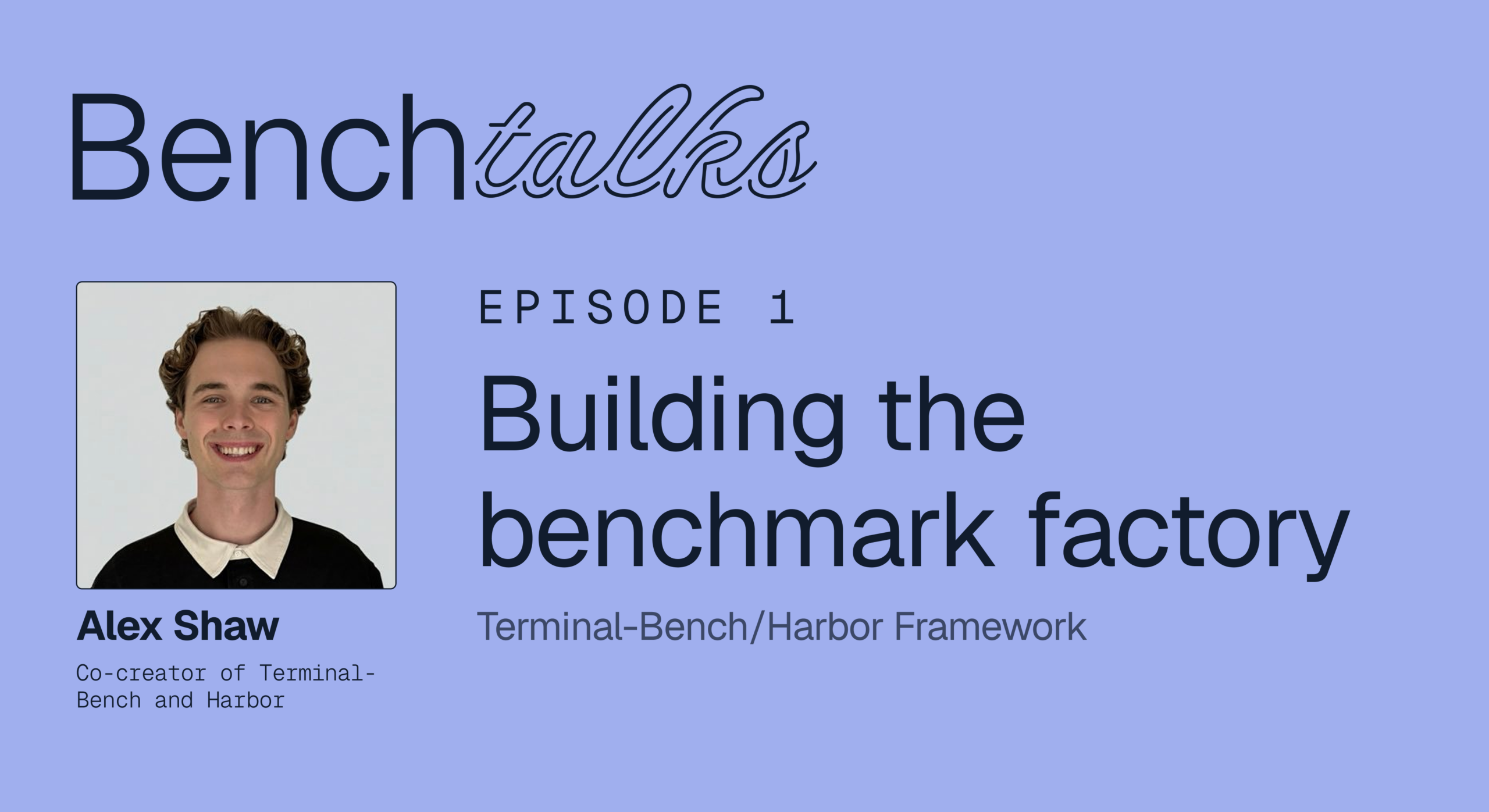
Benchtalks #1: Alex Shaw (Terminal-Bench, Harbor) – Building the Benchmark Factory
Building FinQA: An Open RL Environment for Financial Reasoning Agents


Throughout our lives, we as humans acquire an intuitive understanding of our physical environments, a capacity that supports our imagination and planning abilities. Driven by our own curiosity, we learn about object motion and properties via self-curated targeted experiments, that teach us what we do not know. Recently, neural network models have been proposed that learn forward object dynamics from…

We propose a framework for training sequence tagging models with weak supervision consisting of multiple heuristic rules of unknown accuracy. In addition to supporting rules that vote on tags in the output sequence, we introduce a new type of weak supervision, called linking rules, that vote on how sequence elements should be grouped into spans with the same tag. These…
This work formalizes a deep learning baseline for aortic valve classification and outlines a general strategy for using weak supervision to train machine learning models using unlabeled medical images at scale.
This paper explores the applicability of weak supervision, or relying on higher level, noisier forms of supervision to label training data, specifically using data programming.
Proposing a framework for integrating and modeling such weak supervision sources by viewing them as labeling different related sub-tasks of a problem, which we refer to as the multi-task weak supervision setting
Outlining a vision for a Software 2.0 lifecycle centered around the idea that labeling training data can be the primary interface to Software 2.0 systems.
Presenting Snuba, a system to automatically generate heuristics using a small labeled dataset to assign training labels to a large, unlabeled dataset in the weak supervision setting.
This is first-of-its-kind study showing how existing knowledge resources from across an organization can be used as weak supervision in order to bring development time and cost down by an order of magnitude, and introduce Snorkel DryBell, a new weak supervision management system for this setting
Proposing Slice-based Learning, a new programming model in which the slicing function (SF), a programmer abstraction, is used to specify additional model capacity for each slice.