

We define and advance data and environments to push the AI frontier
building benchmarks and collaborating with



Featured research
Vision and impact
We help labs advance frontier models by working with domain experts to design and build complex, realistic datasets that drive model performance.

Benchmarking &
Evaluation
Build benchmarks that define and advance the AI frontier

Scaling Subject Matter Expertise
Define how subject matter experts encode their knowledge into data

RL, Training, & Data Valuation
Drive dataset development based on feedback from RL and model training
Community and open science
Open benchmarks, conversations, and research for real-world AI performance.
Open Benchmarks Grants
Backed by a $3M commitment, the program funds open-source datasets, benchmarks, and evaluation artifacts that shape how frontier AI systems are built and evaluated.
Bench Talks
Reading Group
DEEP RESEARCH Expertise
Technical advisors and distinguished affiliates








Browse research blogs and academic papers

The future of data-centric AI talk series Background Anima Anandkumar holds dual positions in academia and industry. She is a Bren professor at Caltech and the director of machine learning research at NVIDIA. Anima also has a long list of accomplishments ranging from the Alfred P. Sloan scholarship to the prestigious NSF career award and many more. She recently joined…
Understanding the label model. Machine learning whiteboard (MLW) open-source series Background Frederic Sala, is an assistant professor at the University of Wisconsin-Madison, and a research scientist at Snorkel AI. Previously, he was a postdoc in Chris Re’s lab at Stanford. His research focuses on data-driven systems and weak supervision. In this talk, Fred focuses on weak supervision modeling. This machine…
Moving from Manual to Programmatic Labeling Labeling training data by hand is exhausting. It’s tedious, slow, and expensive—the de facto bottleneck most AI/ML teams face today 1. Eager to alleviate this pain point of AI development, machine learning practitioners have long sought ways to automate this labor-intensive labeling process (i.e., “automated data labeling”) 2, and have reached for classic approaches…
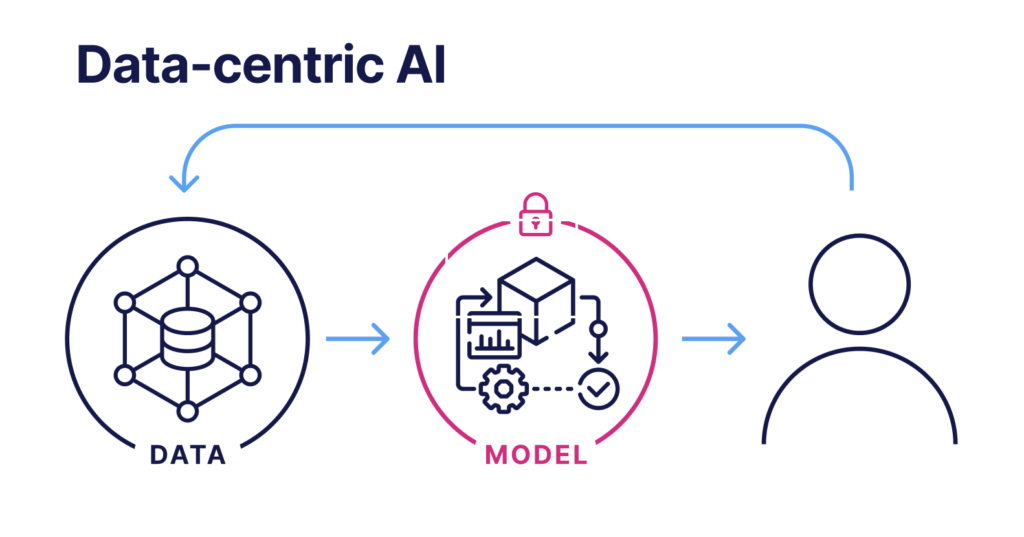
The Future of Data-Centric AI Talk Series Background Alex Ratner is CEO and co-founder of Snorkel AI and an Assistant Professor of Computer Science at the University of Washington. He recently joined the Future of Data-Centric AI event, where he presented the principles of data-centric AI and where it’s headed. If you would like to watch his presentation in full,…
Machine Learning Whiteboard (MLW) Open-source Series Today, Ryan Smith, machine learning research engineer at Snorkel AI, talks about prompting methods with language models and some applications they have with weak supervision. In this talk, we’re essentially going to be using this paper as a template—this paper is a great survey over some methods in prompting from the last few years…
We introduce ThreeDWorld (TDW), a platform for interactive multi-modal physical simulation. TDW enables simulation of high-fidelity sensory data and physical interactions between mobile agents and objects in rich 3D environments. Unique properties include: real-time near-photo-realistic image rendering; a library of objects and environments, and routines for their customization; generative procedures for efficiently building classes of new environments; high-fidelity audio rendering;…
Machine Learning Whiteboard (MLW) Open-source Series We launched the machine learning whiteboard series (MLW) was launched earlier this year as an open-invitation forum to brainstorm ideas and discuss the latest papers, techniques, and workflows in artificial intelligence. Everyone interested in learning about machine learning can participate in an informal and open environment. If you are interested in learning about ML,…
ScienceTalks with Abigail See. Diving into the misconceptions of AI, the challenges of natural language generation (NLG), and the path to large-scale NLG deployment In this episode of Science Talks, Snorkel AI’s Braden Hancock chats with Abigail See, an expert natural language processing (NLP) researcher and educator from Stanford University. We discuss Abigail’s path into machine learning (ML), her previous…
Machine Learning Whiteboard (MLW) Open-source Series For our new visitors, we started our machine learning whiteboard (MLW) series earlier this year as an open-invite space to brainstorm ideas and discuss the latest papers, techniques, and workflows in the AI space. In which, we emphasize an informal and open environment to everyone interested in learning about machine learning. So, if you are interested…