

Machine Learning Whiteboard (MLW) Open-source Series
We launched the machine learning whiteboard series (MLW) was launched earlier this year as an open-invitation forum to brainstorm ideas and discuss the latest papers, techniques, and workflows in artificial intelligence. Everyone interested in learning about machine learning can participate in an informal and open environment. If you are interested in learning about ML, we encourage you to join us on our next ML whiteboard. In this episode, Humza Iqbal, a machine learning research engineer with our research team, talks about “Train and You’ll Miss It: Interactive Model Iteration with Weak Supervision and Pre-Trained Embeddings,” by Mayee F. Chen, Daniel Y. Fu, Frederic Sala, Sen Wu, Ravi Teja Mullapudi, Fait Poms, Kayvon Fatahalian, and Christopher Ré. The reproducible code for Epoxy can be found on Github.This episode is part of the #MLwhiteboard video series hosted by Snorkel AI. Check out the episode here:
With Epoxy, you can train models at programmatically-interactive speeds (less than 1/2 second) while retaining the performance of training deep networks. This Github repository contains a simple Epoxy proof-of-concept implementation (Showing an implementation at approximately 100 lines long, including documentation).Using weak supervision, users can write noisy labeling functions to generate labels for their data. These labeling functions are historically high in accuracy but low in coverage (each voting on a subset of points). Until recently, the only way to fill the gap was to write more labeling functions (which can be challenging as you start dealing with the long tail) or use the labeling functions to train an end model (see, for example, FlyingSquid for more information).By using Epoxy pre-trained embeddings, we obtain some of the benefits of training an end model without actually training one. By using the embeddings and nearest-neighbor search (which improves coverage), we make extended labeling functions and aggregate the functions with FlyingSquid. With this, you gain some of the benefits of deep learning at a fraction of the cost. You can also use Epoxy to generate labels to train a downstream model if you have time to train a deep network.
Abstract:
Our goal is to enable machine learning systems to be trained interactively. This requires models that perform well and train quickly, without large amounts of hand-labeled data. We take a step forward in this direction by borrowing from weak supervision (WS), wherein models can be trained with noisy sources of signal instead of hand-labeled data. But WS relies on training downstream deep networks to extrapolate to unseen data points, which can take hours or days. Pre-trained embeddings can remove this requirement. We do not use the embeddings as features as in transfer learning (TL), which requires fine-tuning for high performance, but instead, use them to define a distance function on the data and extend WS source votes to nearby points. Theoretically, we provide a series of results studying how performance scales with changes in source coverage, source accuracy, and the Lipschitzness of label distributions in the embedding space and compare this rate to standard WS without extension and TL without fine-tuning. On six benchmark NLP and video tasks, our method outperforms WS without extension by 4.1 points, TL without fine-tuning by 12.8 points, and traditionally-supervised deep networks by 13.1 points, and comes within 0.7 points of state-of-the-art weakly-supervised deep networks-all while training in less than half a second.Where to connect with Humza: Linkedin.If you are interested in learning with us, consider joining us at our biweekly ML whiteboard.Stay in touch with Snorkel AI, follow us on Twitter, LinkedIn, Facebook, Youtube, or Instagram, and if you’re interested in joining the Snorkel team, we’re hiring! Please apply on our careers page.

Recommended articles
View all articles
Grok 4.7 on Senior SWE-Bench: Strong pass@3, Cheaper Cost per Trial
Grok 4.7 was evaluated on Senior SWE-Bench, our benchmark for measuring whether coding agents work like senior engineers. It reaches a tasteful pass@3 of 40.0%, up from 38.9% for Grok 4.6, ranking sixth overall at $0.24 per trial, which is a fraction of the cost compared to Opus 4.8. Benchmark Senior SWE-Bench evaluates agents as compared to a senior engineer.
September 21, 2026
•
Snorkel Team
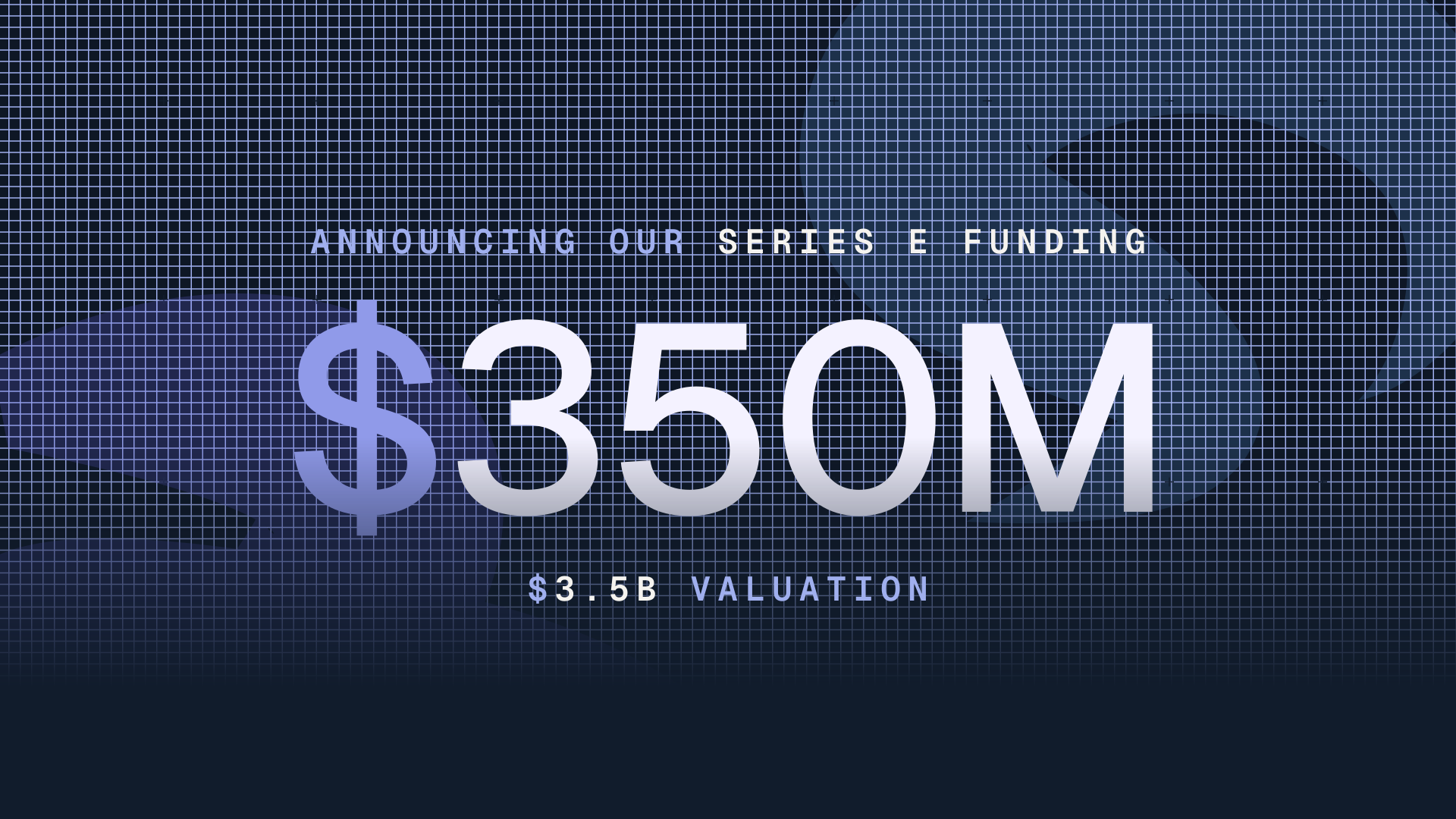
Data 2.0 and the research era of AI data
Today, I’m excited to announce Snorkel’s $350M Series E financing at a $3.5B valuation, led by Insight and S32, with participation from Third Point, March, Blumberg, Allegis, Standard VC, Frontline, and existing investors Addition, Lightspeed, Greylock, GV, P7, Wells Fargo, Walden Catalyst Ventures, and Factory.
September 20, 2026
•
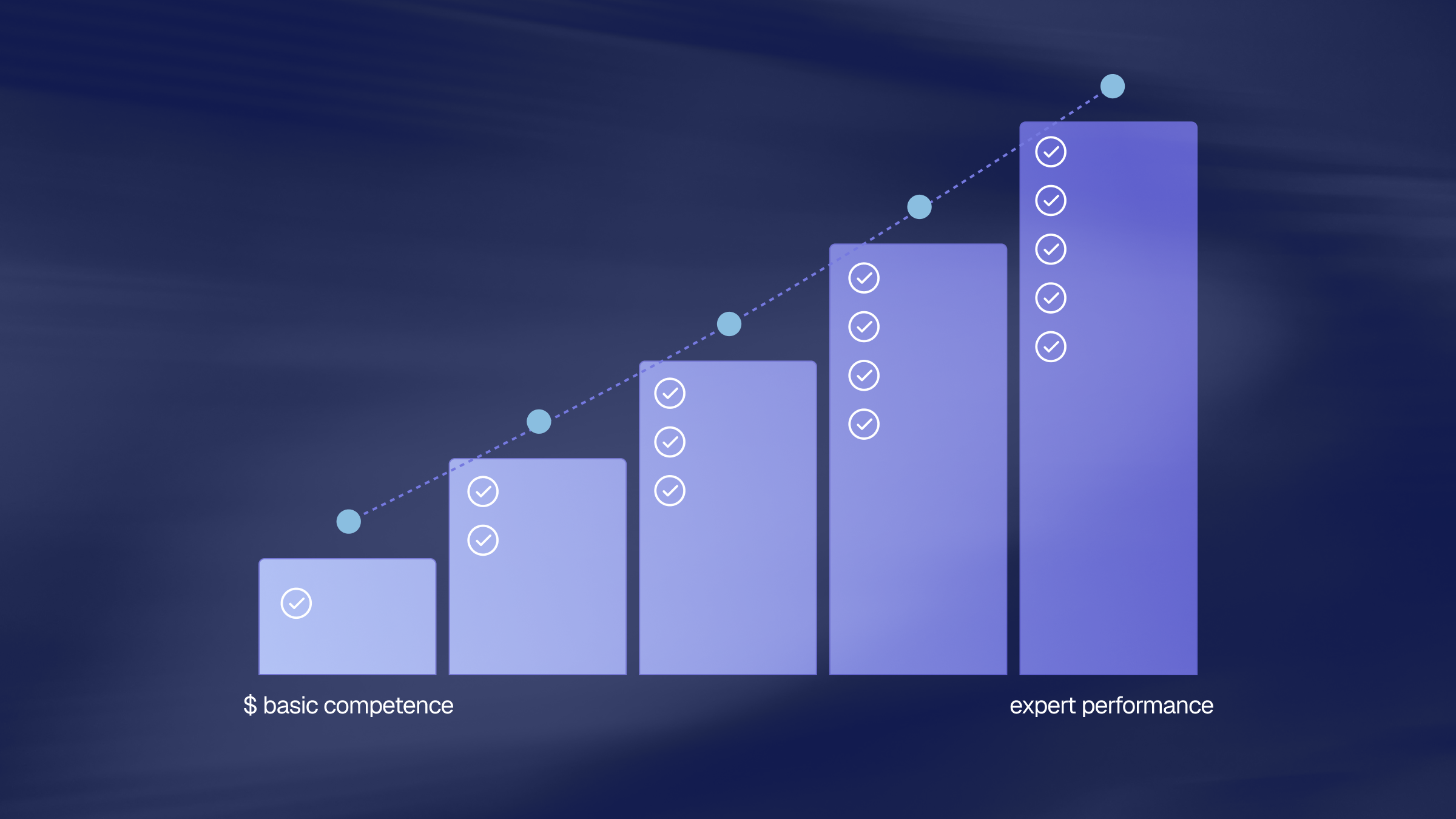
From Foundational Competency to Expert Performance: A Curriculum Approach to Model Development
A student does not go from 1st to 12th grade in a single step. Each grade builds on a specific set of skills, and each one assumes the previous skills have already been mastered. Nobody learns calculus without algebra. When a student skips ahead anyway, what they end up with is memorization rather than understanding. The gaps show up later,
September 15, 2026
•
Snorkel Team