


author
Chief Scientist
,
Snorkel AI
Assistant Professor @ University of Wisconsin-Madison
Frederic Sala is Chief Scientist at Snorkel AI and an assistant professor in the Computer Sciences Department at the University of Wisconsin-Madison. His research studies the fundamentals of data-driven systems and machine learning, with a focus on foundation models, automated machine learning, learning with limited data. Previously, he was a postdoctoral researcher at Stanford. He received his Ph.D. in electrical engineering from UCLA.
The latest from Fred

Efficient representation learning for higher-order data with simplicial complexes
Graph-based machine learning is experiencing explosive growth, driven by impressive recent developments and wide applicability. Typical approaches for graph representation learning predominantly focus on pairwise interactions, while neglecting the patterns of higher-order interactions common to complex systems. This paper explores many-body interaction models, centering on simplicial complexes. From a theoretical point of view, we offer a pair of insights illustrating why higher-order models are necessary, why non-graph-based models generally cannot generalize well, while graph-based models may be able to do so. We conduct experiments on synthetic data, co-citation networks, co-authorship networks and gene-disease associations and show that simplicial complexes with...
Research Paper
Efficient representation learning for higher-order data with simplicial complexes
Graph-based machine learning is experiencing explosive growth, driven by impressive recent developments and wide applicability. Typical approaches for graph representation learning predominantly focus on pairwise interactions, while neglecting the patterns of higher-order interactions common to complex systems. This paper explores many-body interaction models, centering on simplicial complexes. From a theoretical point of view, we offer a pair of insights illustrating…

Good Data from Bad Models: Foundations of Threshold-based Auto-labeling
Creating large-scale high-quality labeled datasets is a major bottleneck in supervised machine learning workflows. Auto-labeling systems are a promising way to reduce reliance on manual labeling for dataset construction. Threshold-based auto-labeling, where validation data obtained from humans is used to find a threshold for confidence above which the data is machine-labeled, is emerging as a popular solution used widely in practice [SGT22, QCG20, SS22]. Given the long shelf-life and diverse usage of the resulting datasets, understanding when the data obtained by such auto-labeling systems can be relied on is crucial. In this work, we analyze threshold-based auto-labeling systems and derive...
Research Paper
Good Data from Bad Models: Foundations of Threshold-based Auto-labeling
Creating large-scale high-quality labeled datasets is a major bottleneck in supervised machine learning workflows. Auto-labeling systems are a promising way to reduce reliance on manual labeling for dataset construction. Threshold-based auto-labeling, where validation data obtained from humans is used to find a threshold for confidence above which the data is machine-labeled, is emerging as a popular solution used widely in…
Domain Generalization with Nuclear Norm Regularization
The ability to generalize to unseen domains is crucial for machine learning systems, especially when we only have data from limited training domains and must deploy the resulting models in the real world. In this paper, we study domain generalization via the classic empirical risk minimization (ERM) approach with a simple regularizer based on the nuclear norm of the learned features from the training set. Theoretically, we provide intuitions on why nuclear norm regularization works better than ERM and ERM with L2 weight decay in linear settings. Empirically, we show that nuclear norm regularization achieves state-of-the-art average accuracy compared to...
Research Paper
Domain Generalization with Nuclear Norm Regularization
The ability to generalize to unseen domains is crucial for machine learning systems, especially when we only have data from limited training domains and must deploy the resulting models in the real world. In this paper, we study domain generalization via the classic empirical risk minimization (ERM) approach with a simple regularizer based on the nuclear norm of the learned…

Automl for climate change: A call to action
The challenge that climate change poses to humanity has spurred a rapidly developing field of artificial intelligence research focused on climate change applications. The climate change AI (CCAI) community works on a diverse, challenging set of problems which often involve physics-constrained ML or heterogeneous spatiotemporal data. It would be desirable to use automated machine learning (AutoML) techniques to automatically find high-performing architectures and hyperparameters for a given dataset. In this work, we benchmark popular AutoML libraries on three high-leverage CCAI applications: climate modeling, wind power forecasting, and catalyst discovery. We find that out-of-the-box AutoML libraries currently fail to meaningfully surpass...
Research Paper
Automl for climate change: A call to action
The challenge that climate change poses to humanity has spurred a rapidly developing field of artificial intelligence research focused on climate change applications. The climate change AI (CCAI) community works on a diverse, challenging set of problems which often involve physics-constrained ML or heterogeneous spatiotemporal data. It would be desirable to use automated machine learning (AutoML) techniques to automatically find…
AutoML Decathlon: Diverse Tasks, Modern Methods, and Efficiency at Scale
The vision of Automated Machine Learning (AutoML) is to produce high performing ML pipelines that require very little human involvement or domain expertise to use. Competitions and benchmarks have been critical tools for accelerating progress in AutoML. However, much of the prior work on AutoML competitions has focused on well-studiedd omains in machine learning such as vision and language—these are domains which have benefited from several years of ML pipeline design by domain experts, which brings the usage of AutoML into question in the first place. Recently, AutoML for diverse tasks has emerged as an important research area that aims...
Research Paper
AutoML Decathlon: Diverse Tasks, Modern Methods, and Efficiency at Scale
The vision of Automated Machine Learning (AutoML) is to produce high performing ML pipelines that require very little human involvement or domain expertise to use. Competitions and benchmarks have been critical tools for accelerating progress in AutoML. However, much of the prior work on AutoML competitions has focused on well-studiedd omains in machine learning such as vision and language—these are…

Causal Omnivore: Fusing Noisy Estimates of Spurious Correlations
Spurious correlations are one of the biggest pain points for users of modern machine learning. To handle this issue, many approaches attempt to learn features that are causally linked to the prediction variable. Such techniques, however, suffer from various flaws—they are often prohibitively complex or based on heuristics and strong assumptions that may fail in practice. There is no onesize-fits-all causal feature identification approach. To address this challenge, we propose a simple way to fuse multiple noisy estimates of causal features. Our approach treats the underlying causal structure as a latent variable and exploits recent developments in estimating latent structures...
Research Paper
Causal Omnivore: Fusing Noisy Estimates of Spurious Correlations
Spurious correlations are one of the biggest pain points for users of modern machine learning. To handle this issue, many approaches attempt to learn features that are causally linked to the prediction variable. Such techniques, however, suffer from various flaws—they are often prohibitively complex or based on heuristics and strong assumptions that may fail in practice. There is no onesize-fits-all…
NAS-Bench-360: Benchmarking Neural Architecture Search on Diverse Tasks
Most existing neural architecture search (NAS) benchmarks and algorithms prioritize well-studied tasks, e.g. image classification on CIFAR or ImageNet. Thismakes the performance of NAS approaches in more diverse areas poorly understood. In this paper, we present NAS-Bench-360, a benchmark suite to evaluate methods on domains beyond those traditionally studied in architecture search, and use it to address the following question: do state-of-the-art NAS methods perform well on diverse tasks? To construct the benchmark, we curate ten tasks spanning a diverse array of application domains, dataset sizes, problem dimensionalities, and learning objectives. Each new task is carefully chosen to interoperate with...
Research Paper
NAS-Bench-360: Benchmarking Neural Architecture Search on Diverse Tasks
Most existing neural architecture search (NAS) benchmarks and algorithms prioritize well-studied tasks, e.g. image classification on CIFAR or ImageNet. Thismakes the performance of NAS approaches in more diverse areas poorly understood. In this paper, we present NAS-Bench-360, a benchmark suite to evaluate methods on domains beyond those traditionally studied in architecture search, and use it to address the following question:…
Blog
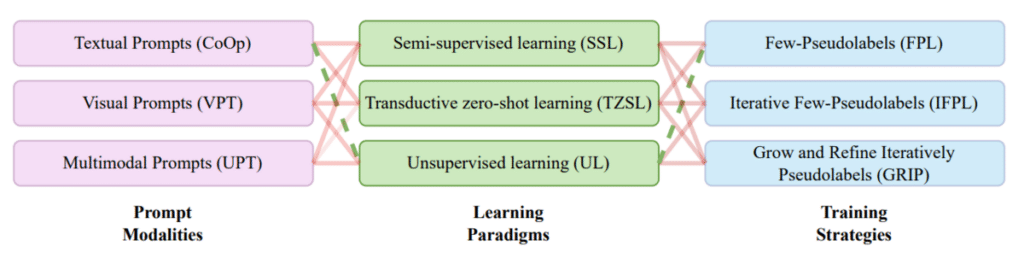
4 new papers show foundation models can build on themselves
The surest way to improve foundation models is through more and better data, but Snorkel researchers showed FMs can learn from themselves.
Blog
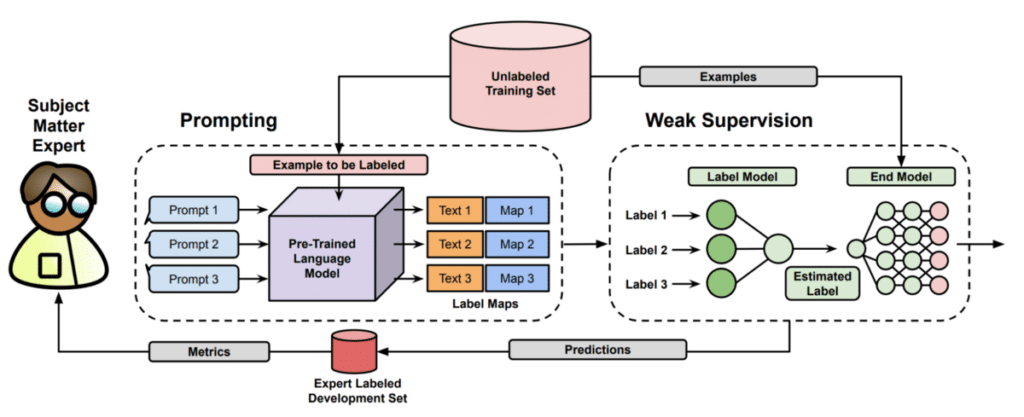
Getting better performance from foundation models (with less data)
Getting better performance from foundation models (with less data)