


TL;DR: We stress-tested the “generate → criticize → improve” loop on 50 visual reasoning tasks. The results were counterintuitive: self-critique acts as a corrosive agent on high-performance tasks, turning 98% accuracy into 57%. Yet, for tasks where models fail completely, it works like magic. This difficulty-dependent behavior poses a critical, hidden risk for RLFT pipelines.
The Promise vs. The Reality
The “agentic loop”—having an AI critique and improve its own work—is a popular method for attempting to boost performance. Techniques like Self-Refine (Madaan et al., 2023) and Reflexion (Shinn et al., 2023) have popularized the idea that iterative feedback can help models solve complex tasks. The logic is simple: two heads (even if they’re the same head) are better than one.
But are they always?
We ran a rigorous experiment:
- 50 hard visual reasoning tasks (verifiable ground truth)
- 2 frontier models (Claude Sonnet 4.5, OpenAI o4-mini)
- 5 critique-improve iterations per task
- 100 total experiments
Why these models? We chose two of the strongest reasoning models available. If SOTA models—specifically optimized for reasoning—cannot leverage self-critique to fix their own outputs on simple tasks, it suggests a fundamental limitation that is likely even more severe in weaker or smaller models.
What we found challenges the core assumption of agentic AI.
The Data: A Tale of Two Extremes
When we aggregated our results, it looked like a generic failure: accuracy dropped 10% overall. But when we split tasks by difficulty, a startling pattern emerged.
1. The “Corrosive Critique” Effect (Easy Tasks)
For tasks where models started strong (≥75% accuracy), the critique loop was devastating for both models.

| Model | Initial | Loop 5 | Drop | Result |
|---|---|---|---|---|
| Claude Sonnet 4.5 | 98.1% | 56.9% | ↓ 41.2% | 0 improved, 8 degraded |
| OpenAI o4-mini | 94.2% | 78.4% | ↓ 15.8% | 0 improved, 5 degraded |
What happened? Hallucination. The critic, primed to find errors, invented them. A correct answer of “yes” became “no” because the model “detected” a 2-pixel discrepancy that didn’t exist. Confidence became a liability.
2. The “Lazarus” Effect (Hard Tasks)
For tasks where models failed completely (<35% accuracy), critique was a miracle worker.
| Model | Initial | Loop 5 | Gain | Result |
|---|---|---|---|---|
| Claude Sonnet 4.5 | 0.0% | 60.0% | ↑ 60.0% | 3 improved, 0 degraded |
| OpenAI o4-mini | 0.0% | 20.0% | ↑ 20.0% | 1 improved, 0 degraded |
Here, the critic had real errors to catch—calculation mistakes, logic inversions—and debugging actually worked. This universality across models suggests a fundamental property of LLM reasoning, not a quirk of one architecture.
The Hidden Danger for Model Training
This finding has profound implications beyond just prompt engineering. It strikes at the heart of modern model training, particularly Reinforcement Learning Fine-Tuning (RLFT) and Reinforcement Learning from AI Feedback (RLAIF).
The Reward Modeling Trap
In RLFT/RLAIF pipelines, we often use a strong model (the “Judge”) to score the outputs of a model being trained. If the Judge is the same model (or a similar one), our results suggest a dangerous feedback loop:
- Penalty for Perfection: If the student model gets an easy task right, the Judge might hallucinate a flaw and penalize it.
- Reward for Uncertainty: The Judge may prefer hedged, uncertain answers over confident, correct ones to avoid “missed” errors.
- Drift: Over time, this could train models to be less decisive on simple tasks while over-correcting on complex ones.
If your reward model (Judge) has the same blind spots as your policy model, self-correction isn’t just useless—it’s an adversarial attack on your own training data.
When to Use Critique in Agentic Solutions
The data is clear: Self-critique is not a free lunch. It’s a high-stakes bet that only pays off when you’re already losing.
The Core Strategy: Triage Your Tasks
Don’t apply a flat “3 loops” policy to everything. You must categorize incoming requests by difficulty or risk corrosive effects.
1. The “Red Zone” (Easy Tasks) -> ZERO Loops
Identify them by: Simple classification, high initial confidence (>90%), or tasks where LLMs historically excel (e.g., sentiment analysis, basic extraction).
Action: Trust the first draft. Critique here is actively harmful (↓15-40% accuracy).
Why: The model is right, but the critic will hallucinate flaws to justify its existence.
2. The “Green Zone” (Hard Tasks) -> 3-5 Loops
Identify them by: Complex reasoning, multi-step logic, or low initial confidence (<50%).
Action: Force critique loops.
Why: The model is likely wrong initially. The critic acts as a debugger, catching calculation errors or logic gaps that the generator missed.
The Golden Rule for Agents
Critique is for debugging, not polishing.
If your agent is confident and the task is standard, shut the critic up. Only engage the loop when the model is struggling or the task complexity demands a “second pair of eyes” to catch structural errors.
References
- Self-Refine: Madaan, A., et al. (2023). Self-Refine: Iterative Refinement with Self-Feedback. arXiv:2303.17651.
- Reflexion: Shinn, N., et al. (2023). Reflexion: Language Agents with Verbal Reinforcement Learning. arXiv:2303.11366.

Armin Parchami
Director of Research Engineering
Armin Parchami is the Director of Research Engineering at Snorkel AI, where he leads work on synthetic data, data quality, and model fine-tuning. He previously held technical leadership roles at Ford and Nokia Bell Labs, focusing on multimodal AI and autonomy. His work centers on moving research into production.
Recommended articles
View all articles
Grok 4.7 on Senior SWE-Bench: Strong pass@3, Cheaper Cost per Trial
Grok 4.7 was evaluated on Senior SWE-Bench, our benchmark for measuring whether coding agents work like senior engineers. It reaches a tasteful pass@3 of 40.0%, up from 38.9% for Grok 4.6, ranking sixth overall at $0.24 per trial, which is a fraction of the cost compared to Opus 4.8. Benchmark Senior SWE-Bench evaluates agents as compared to a senior engineer.
September 21, 2026
•
Snorkel Team
Data 2.0 and the research era of AI data
Today, I’m excited to announce Snorkel’s $350M Series E financing at a $3.5B valuation, led by Insight and S32, with participation from Third Point, March, Blumberg, Allegis, Standard VC, Frontline, and existing investors Addition, Lightspeed, Greylock, GV, P7, Wells Fargo, Walden Catalyst Ventures, and Factory.
September 20, 2026
•
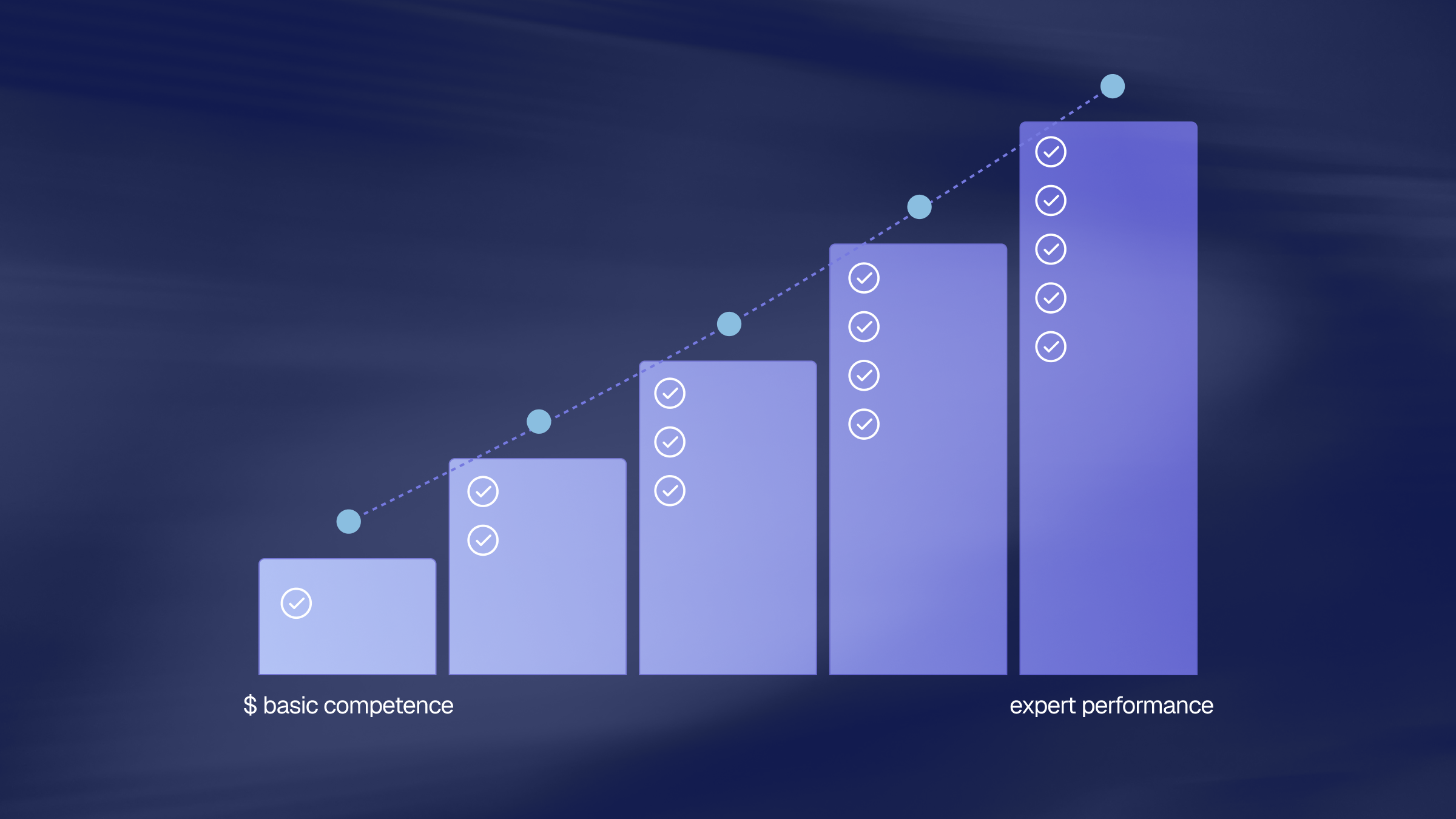
From Foundational Competency to Expert Performance: A Curriculum Approach to Model Development
A student does not go from 1st to 12th grade in a single step. Each grade builds on a specific set of skills, and each one assumes the previous skills have already been mastered. Nobody learns calculus without algebra. When a student skips ahead anyway, what they end up with is memorization rather than understanding. The gaps show up later,
September 15, 2026
•
Snorkel Team