

Our customers have made clear that they need role-based access controls, and we’ve listened. As a product lead at Snorkel, I’m thrilled to share that we’ve released a new feature in our 2024.R1 product update specifically focused on data upload access controls.
This development is a direct response to feedback from our enterprise customers who need greater control over what data enters and leaves their systems. We’re confident this new capability will significantly enhance our enterprise readiness.
Let’s take a look at how it works.
Data access controls: an enterprise necessity
Enterprises (especially banks and firms in other highly regulated industries) need to control what data leaves their organization and how. Administrators must gate and approve the egress of proprietary data to prevent conflicts with the company’s security guidelines and federal regulations. If they allow employees and teams to arbitrarily access data and bring it onto an external platform, they could quickly run into a problem.
This, of course, includes moving data from the enterprise environment into the Snorkel Flow AI data development platform.

Snorkel’s response: role-based access controls
To address our customers’ data access control needs, we have begun developing and deploying new features that allow admins to restrict what types of data can be imported into Snorkel Flow. Admins can now disable or enable different data connectors, effectively locking down what data your users can import into the platform.
Administrators can configure ingress controls both by role and by workspace. For example, they can enable access for SQL for data annotators in one workspace, Snowflake for data scientists in another workspace, and lock down local file upload for all roles across all workspaces.

Control down to the configuration level
These features allow administrators to further refine access controls. For each role, each workplace, and each data upload method, administrators can decide which roles can interact with connection configurations and how. For example, they can choose to only allow administrators and super administrators to add or edit configurations for the company’s SQL database. They can allow developers to view and use existing configurations without modifying them. Still others, like annotators, could be locked out of all data ingress entirely.
This multi-level configuration control allows specificity in managing data access, ensuring that only the right people access the right data, enhancing both security and operational efficiency.
These granular controls are a testament to Snorkel’s commitment to providing robust and flexible solutions for enterprise data management. We understand that every enterprise has unique needs and challenges, and we are dedicated to providing tools that can be tailored to meet these specific requirements.

Role-based access control impact on enterprise AI
These new features provide several benefits. First, it significantly improves data security by ensuring that only authorized users can import data into Snorkel Flow. Second, it ensures data integrity by controlling what data can come in and out of the system. Lastly, it can improve efficiency in workflow, by preventing Snorkel Flow users from stumbling down the wrong path with the wrong data.
This release is just the start. Over the next year or two, we plan to offer the ability to gate both data ingress and egress. We also plan to investigate improvements to feature access control. This will lead us to a world where admins can define their own custom roles that align closely with their active directory representation of their entitlements.
RBAC in Snorkel Flow: a step forward
Snorkel Flow’s new data upload access control features represent a significant step forward in enhancing our enterprise readiness. It gives our customers much-needed control over what data comes in and out of their systems, improving data security and integrity while also enhancing workflow efficiency.
We encourage all our customers to explore this new feature and see how it can benefit their operations. As always, if you have any questions or feedback, feel free to reach out to us. We’re excited to hear from you and look forward to continually improving Snorkel Flow to better serve your needs.
Ready to accelerate AI development?
Deploy production AI and ML applications 10-100x faster with Snorkel’s experts, using our proprietary technology.

Daniel Xu
Product Lead
Daniel Xu is Snorkel AI’s infrastructure product leader with extensive experience in building enterprise and security platforms.
Previously at Facebook, he led two teams in Privacy infrastructure, focusing on protecting user data through identifying and implementing anti-scraping mitigations on both 1st party apps and 3P developer platforms. Daniel has also served as Tech Lead and Product Manager at DataVisor focused on deploying anti-fraud / anti-bot solutions for both US F500 and Chinese companies, and held a Product Manager role at Addepar specializing in building financial analytics platforms for wealth managers and family offices.
He holds a Bachelor of Applied Science from the University of California, Berkeley, providing a strong academic foundation. Daniel excels in driving highly technical product strategy, leading teams, and delivering innovative solutions in data-driven environments.
Recommended articles
View all articles
Grok 4.7 on Senior SWE-Bench: Strong pass@3, Cheaper Cost per Trial
Grok 4.7 was evaluated on Senior SWE-Bench, our benchmark for measuring whether coding agents work like senior engineers. It reaches a tasteful pass@3 of 40.0%, up from 38.9% for Grok 4.6, ranking sixth overall at $0.24 per trial, which is a fraction of the cost compared to Opus 4.8. Benchmark Senior SWE-Bench evaluates agents as compared to a senior engineer.
September 21, 2026
•
Snorkel Team
Data 2.0 and the research era of AI data
Today, I’m excited to announce Snorkel’s $350M Series E financing at a $3.5B valuation, led by Insight and S32, with participation from Third Point, March, Blumberg, Allegis, Standard VC, Frontline, and existing investors Addition, Lightspeed, Greylock, GV, P7, Wells Fargo, Walden Catalyst Ventures, and Factory.
September 20, 2026
•
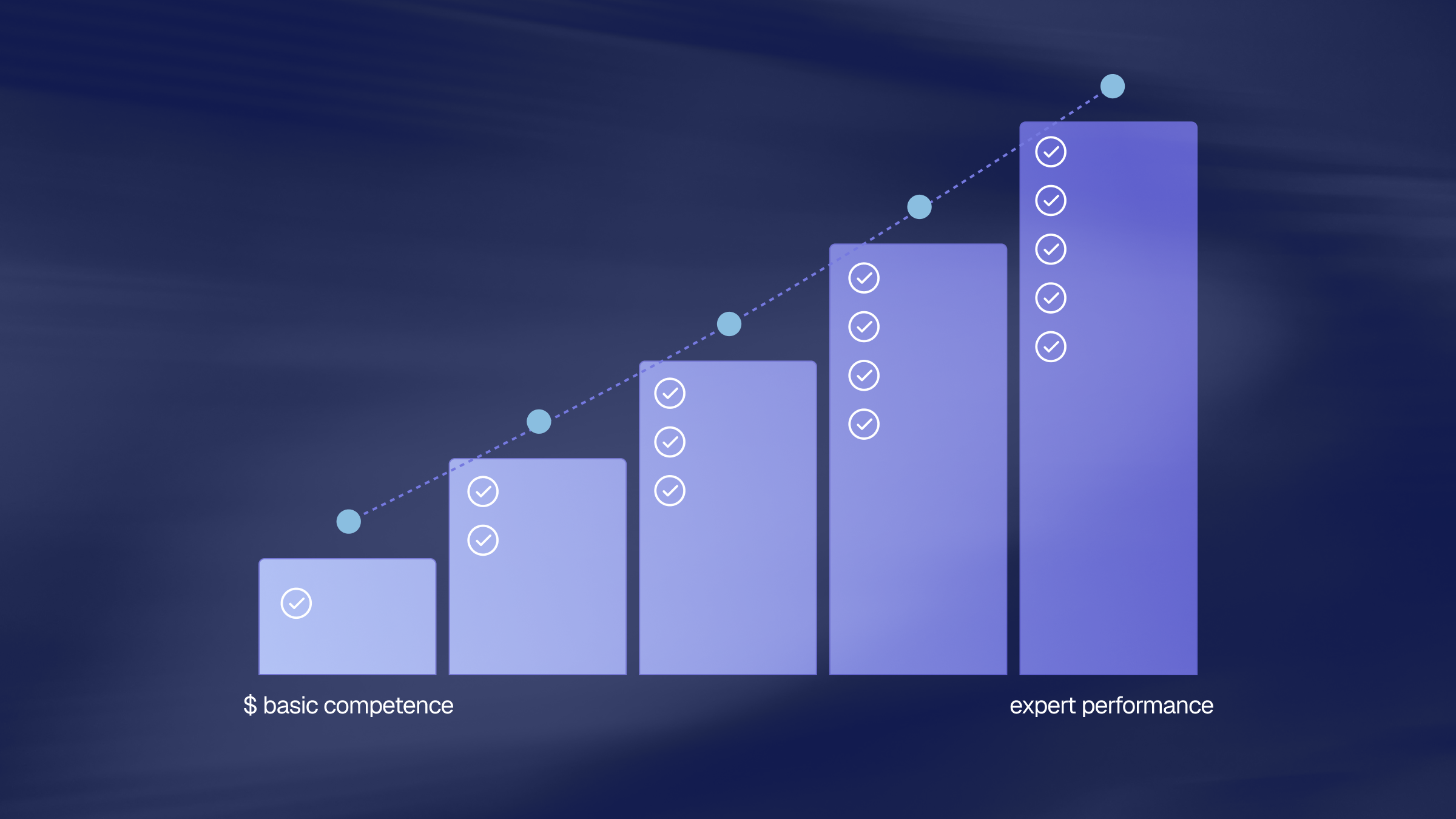
From Foundational Competency to Expert Performance: A Curriculum Approach to Model Development
A student does not go from 1st to 12th grade in a single step. Each grade builds on a specific set of skills, and each one assumes the previous skills have already been mastered. Nobody learns calculus without algebra. When a student skips ahead anyway, what they end up with is memorization rather than understanding. The gaps show up later,
September 15, 2026
•
Snorkel Team