

Machine Learning Whiteboard (MLW) Open-source Series
Our machine learning whiteboard (MLW) is an open-invite space to brainstorm ideas and discuss the latest papers, techniques, and workflows in the AI space. We emphasize an informal and open environment to everyone interested in discovering more about machine learning.In this episode, Hiromu Hota, Vincent Sunn Chen, Daniel Y. Fu, and Frederic Sala dive into “Multi-Resolution Weak Supervision for Sequential Data,” a paper authored by Frederic Sala, Paroma Varma, Jason Fries, Daniel Y. Fu, Shiori Sagawa, Saelig Khattar, Ashwini Ramamoorthy, Ke Xiao, Kayvon Fatahalian, James Priest, and Christopher Ré presented at NeurIPS 2019.This episode is part of the #MLwhiteboard video series hosted by Snorkel AI. Check out the episode here:
Abstract:
Since manually labeling training data is slow and expensive, recent industrial and scientific research efforts have turned to weaker or noisier forms of supervision sources. However, existing weak supervision approaches fail to model multi-resolution sources for sequential data, like video, that can assign labels to individual elements or collections of elements in a sequence. A key challenge in weak supervision is estimating the unknown accuracies and correlations of these sources without using labeled data. Multi-resolution sources exacerbate this challenge due to complex correlations and sample complexity that scales in the length of the sequence. We propose Dugong, the first framework to model multi-resolution weak supervision sources with complex correlations to assign probabilistic labels to training data. Theoretically, we prove that Dugong, under mild conditions, can uniquely recover the unobserved accuracy and correlation parameters and use parameter sharing to improve sample complexity. Our method assigns clinician-validated labels to population-scale biomedical video repositories, helping outperform traditional supervision by 36.8 F1 points and addressing a key use case where machine learning has been severely limited by the lack of expert labeled data. On average, Dugong improves over traditional supervision by 16.0 F1 points and existing weak supervision approaches by 24.2 F1 points across several video and sensor classification tasks.
If you are interested in learning with us, consider joining us at our biweekly ML whiteboard.If you’re interested in staying in touch with Snorkel AI, follow us on Twitter, LinkedIn, Facebook, Youtube, or Instagram, and if you’re interested in joining the Snorkel team, we’re hiring! Please apply on our careers page.

Recommended articles
View all articles
Grok 4.7 on Senior SWE-Bench: Strong pass@3, Cheaper Cost per Trial
Grok 4.7 was evaluated on Senior SWE-Bench, our benchmark for measuring whether coding agents work like senior engineers. It reaches a tasteful pass@3 of 40.0%, up from 38.9% for Grok 4.6, ranking sixth overall at $0.24 per trial, which is a fraction of the cost compared to Opus 4.8. Benchmark Senior SWE-Bench evaluates agents as compared to a senior engineer.
September 21, 2026
•
Snorkel Team
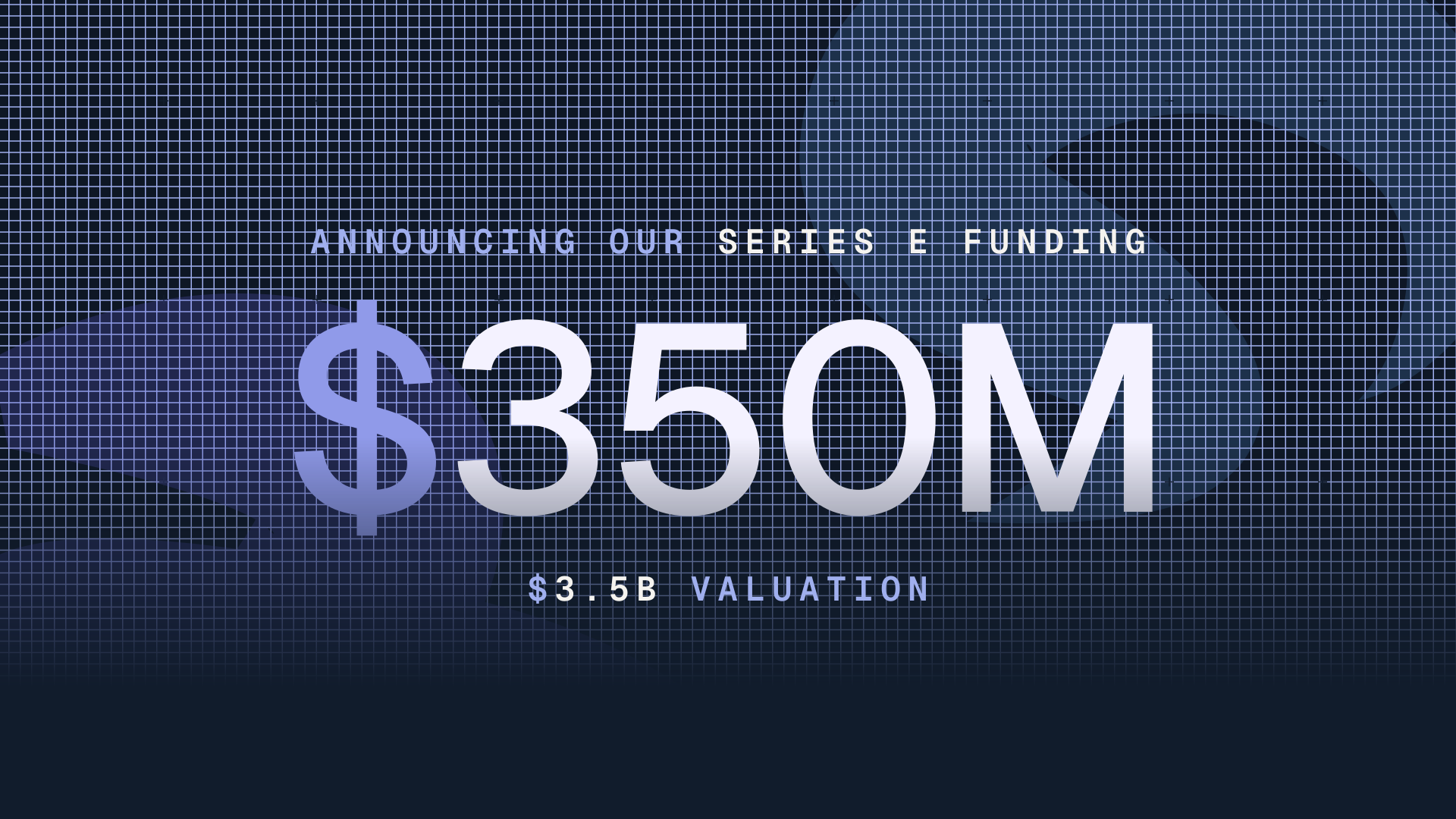
Data 2.0 and the research era of AI data
Today, I’m excited to announce Snorkel’s $350M Series E financing at a $3.5B valuation, led by Insight and S32, with participation from Third Point, March, Blumberg, Allegis, Standard VC, Frontline, and existing investors Addition, Lightspeed, Greylock, GV, P7, Wells Fargo, Walden Catalyst Ventures, and Factory.
September 20, 2026
•
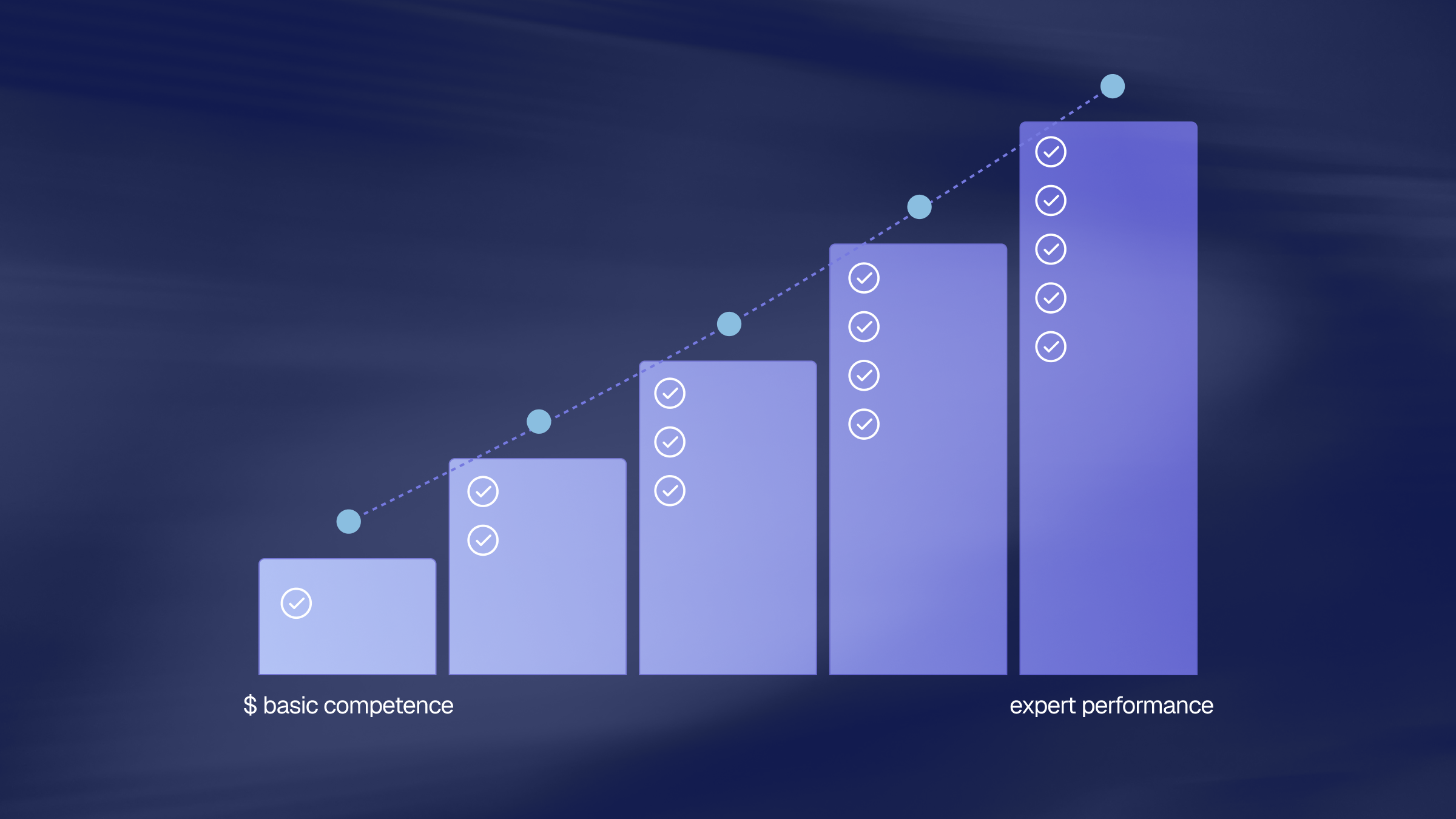
From Foundational Competency to Expert Performance: A Curriculum Approach to Model Development
A student does not go from 1st to 12th grade in a single step. Each grade builds on a specific set of skills, and each one assumes the previous skills have already been mastered. Nobody learns calculus without algebra. When a student skips ahead anyway, what they end up with is memorization rather than understanding. The gaps show up later,
September 15, 2026
•
Snorkel Team