


As AI coding agents become increasingly capable, the need for rigorous, real-world evaluation has never been more critical. Today, we’re sharing details about the Snorkel Agentic Coding benchmark—a comprehensive evaluation suite designed to test whether agents can handle the full complexity of software engineering work.
Challenging for Frontier Models
We’ve been listening to our customers as they describe the challenges they face pushing the frontier of coding capabilities, and we’ve applied what we’ve learned from those conversations to developing a benchmark that delivers meaningful feedback about the strengths and weaknesses of even the most advanced models. The Snorkel Agentic Coding benchmark comprises 100 multi-step coding tasks, distributed across four difficulty tiers. These tasks span the breadth of capabilities needed for real-world software engineering: from command-line operations and tool use to building, debugging, and refactoring complex codebases.

The benchmark focuses on the key areas where coding assistants need to grow. Tasks range from typical software engineering challenges to advanced ML and data analytics work, build and dependency management, and more. Each task evaluates not just whether an agent can write code, but whether it can plan across long horizons, track multiple subtasks, evaluate and execute its own solutions, and recover from errors or incorrect previous steps.
What sets this benchmark apart is its flexibility to assess model performance over codebases written in multiple languages. Snorkel Agentic Coding is effective at evaluating model behavior and verifying solutions across a wide range of syntaxes, including tasks that require coding in two or more languages to be completed successfully.
Built on Expert Validation and Real Execution
Drawing on insights from our contributions to the Terminal-Bench project, we evaluate agents in fully sandboxed execution environments that provide dynamic feedback and context over long-horizon objectives. This isn’t about single-turn bug fixing or code completion—it’s about end-to-end software engineering.
Every task is paired with a human-validated reference solution, comprehensive unit tests, and scoring rubrics that assess both final outputs and the agent’s trajectory. Our experts confirm that each challenge is solvable in its environment and verify the reliability of all dependencies. This level of validation ensures that when an agent fails, it’s a meaningful signal about capability gaps, not environment issues.
Calibrated for the Full Spectrum
We’ve built this benchmark to challenge even the most advanced frontier models while remaining useful across the cost-performance spectrum. The four difficulty tiers deliver meaningful feedback whether you’re pursuing Pareto-optimal results (-flash, -fast, -mini) or pushing the boundaries of frontier-level capabilities.
This calibration matters. A benchmark that only the best models can solve provides limited signal. One that’s too easy fails to differentiate capabilities. Our approach ensures that teams working with different models can extract actionable insights about where their agents excel and where they need improvement. For example, the breakdown below shows how some frontier models performed on tasks at each difficulty level.

Evaluation Methodology
Models are evaluated using the Pass@5 metric through the Harbor evaluation harness. Each task has a specific timeout limit, with an absolute maximum of 30 minutes for both agent and verifier. This methodology balances thoroughness with practicality—giving agents sufficient time to demonstrate their capabilities while maintaining realistic constraints for consistent, reproducible evaluation.
What This Means for AI Development
As AI’s jagged frontier makes it harder to predict where models will excel and where they will struggle, environment-based dynamic evaluation of their true capabilities becomes essential. The Snorkel Agentic Coding benchmark provides a window into how well these systems handle the messy, multi-faceted reality of software engineering—not just in isolated coding tasks, but across the full spectrum of activities that define the discipline. At Snorkel, we use the insights gained from Agentic Coding and our other benchmarks to tailor custom datasets that augment and refine frontier models’ capabilities. We’re excited to see how this benchmark helps teams build more capable, reliable coding agents that can genuinely augment human developers in their work. If your organization needs specialized, expert-verified, top quality data, come talk to us!

Kobie Crawford
AI/ML Developer Advocate
Kobie Crawford is a Developer Advocate at Snorkel AI, with a focus on engaging AI research and development communities. He comes to Snorkel after a successful journey with MosaicML and Databricks, the latter acquiring the former in 2023.
Recommended articles
View all articles
Grok 4.7 on Senior SWE-Bench: Strong pass@3, Cheaper Cost per Trial
Grok 4.7 was evaluated on Senior SWE-Bench, our benchmark for measuring whether coding agents work like senior engineers. It reaches a tasteful pass@3 of 40.0%, up from 38.9% for Grok 4.6, ranking sixth overall at $0.24 per trial, which is a fraction of the cost compared to Opus 4.8. Benchmark Senior SWE-Bench evaluates agents as compared to a senior engineer.
September 21, 2026
•
Snorkel Team
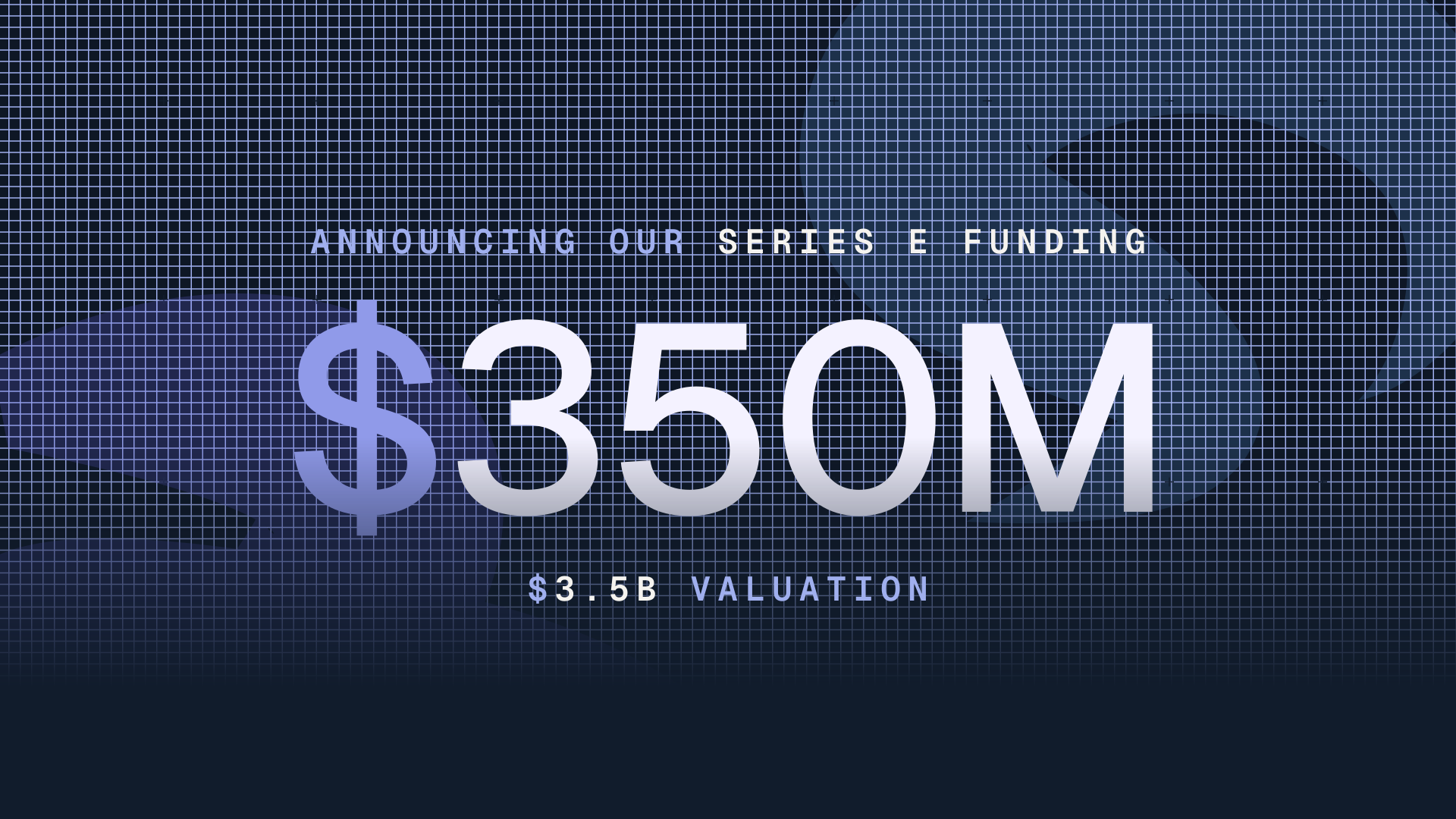
Data 2.0 and the research era of AI data
Today, I’m excited to announce Snorkel’s $350M Series E financing at a $3.5B valuation, led by Insight and S32, with participation from Third Point, March, Blumberg, Allegis, Standard VC, Frontline, and existing investors Addition, Lightspeed, Greylock, GV, P7, Wells Fargo, Walden Catalyst Ventures, and Factory.
September 20, 2026
•
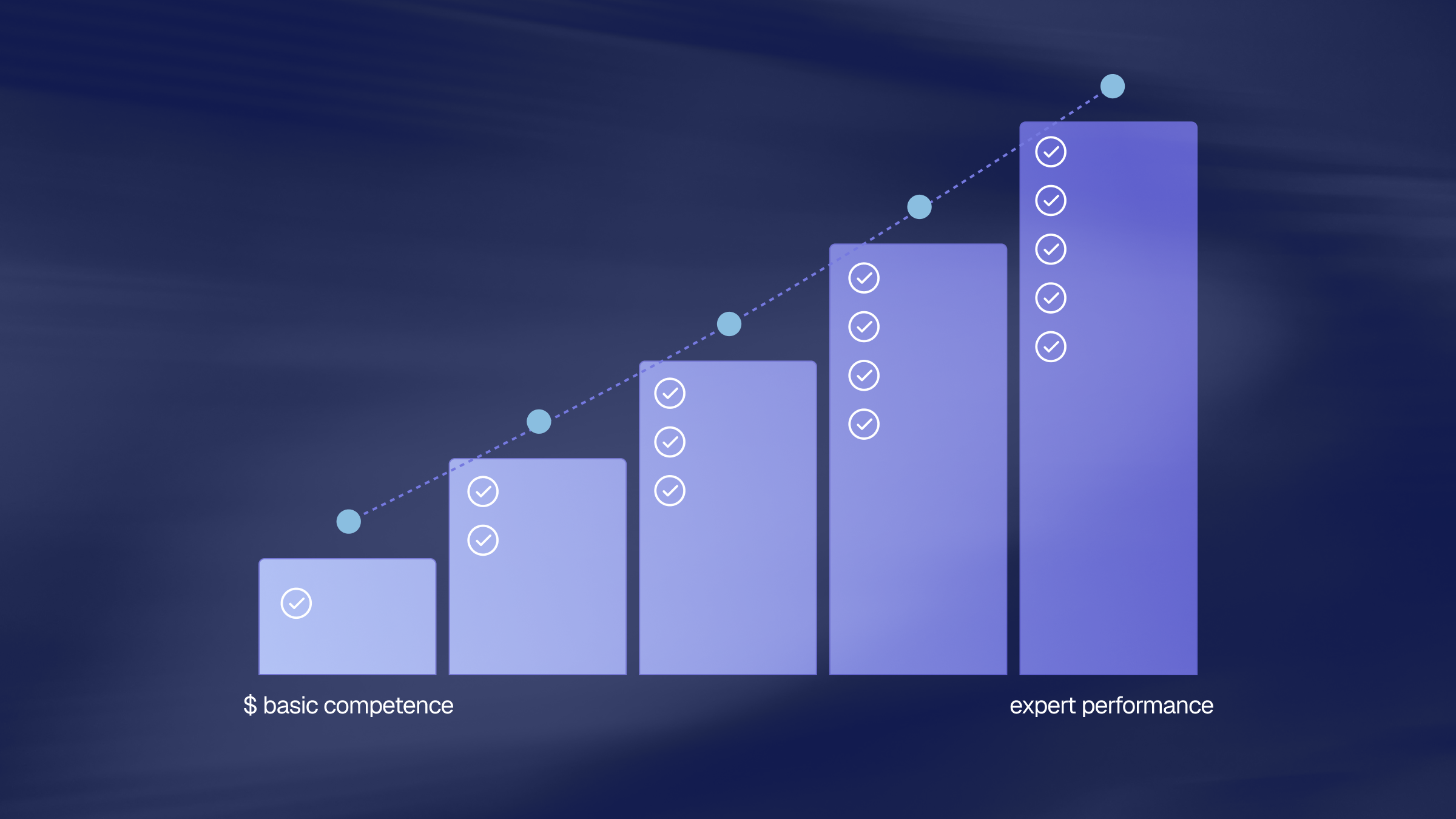
From Foundational Competency to Expert Performance: A Curriculum Approach to Model Development
A student does not go from 1st to 12th grade in a single step. Each grade builds on a specific set of skills, and each one assumes the previous skills have already been mastered. Nobody learns calculus without algebra. When a student skips ahead anyway, what they end up with is memorization rather than understanding. The gaps show up later,
September 15, 2026
•
Snorkel Team