

Table of contents
Introduction
Today, I’m incredibly excited to announce Snorkel’s $[350]M Series E financing [and employee tender] at a $3.5B valuation, co-led by Insight Partners and S32, with significant participation from existing investor Addition. The round included new investors March Capital, Blumberg Capital, Allegis Capital, Frontline, Standard, One Prime Capital, Third Point Ventures, and D.E. Shaw Ventures, along with existing investors Greylock, Lightspeed, GV, Factory, BlackRock, Prosperity7, and Wells Fargo.
Over the last year, our technology and research-centric approach to AI data development has driven [18x+] YoY growth and helped us cross a $[350M] annualized revenue run rate in just twelve months. We’re grateful to the customers and partners who enabled this, and excited to invest this new funding in supporting their continued success.
Snorkel started as a research project a decade ago at Stanford, founded on the idea that AI would inevitably become “data-centric”, and that data deserved to be the centerpoint of proper academic study.
Snorkel then spun out as a company [X] years ago, founded on the idea that AI data should be approached as a software technology problem – not just a staffing or crowdsourcing one.
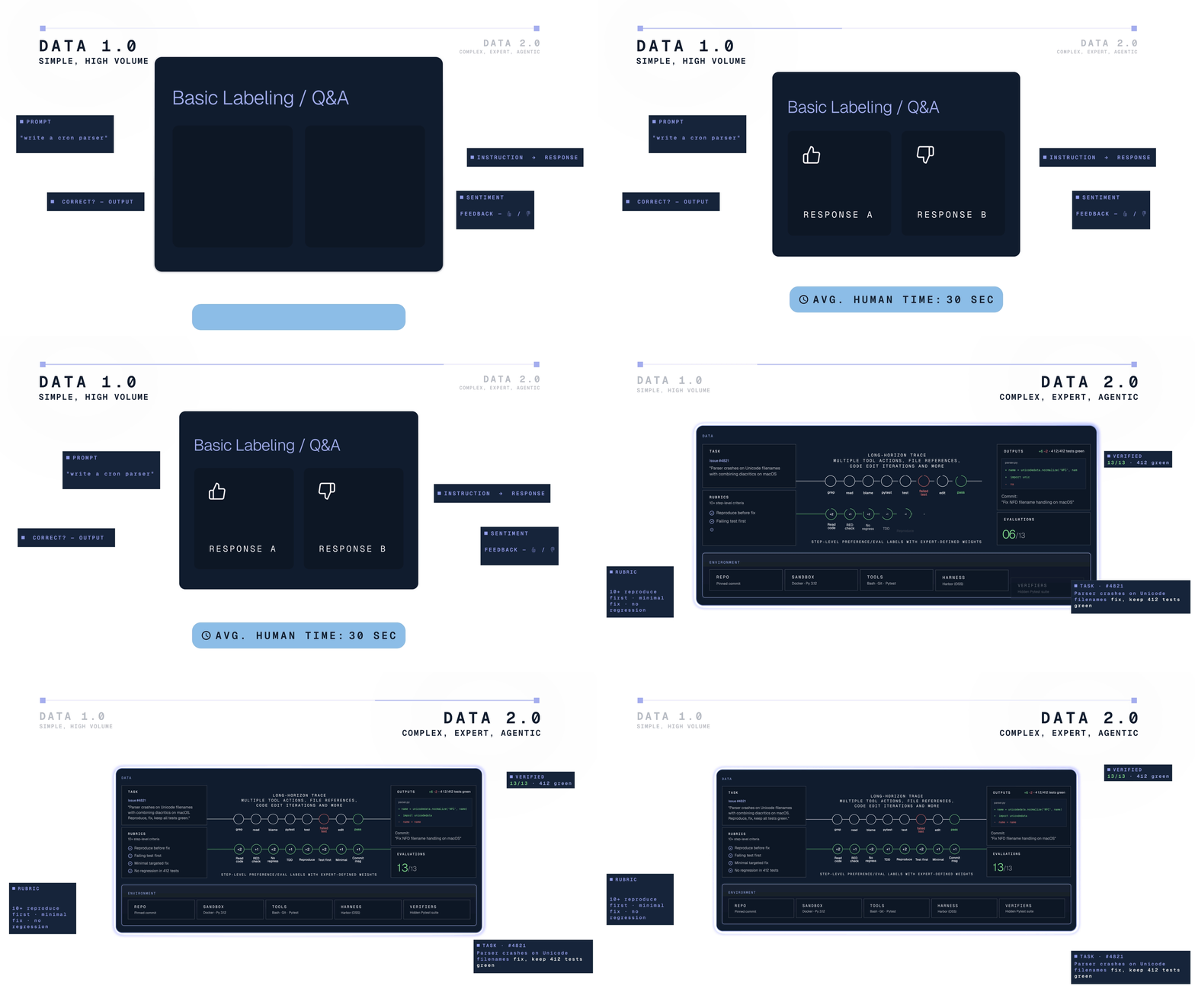
Today, this research- and software-centric approach to AI data is more important than ever before. AI data needs have gone through a fundamental phase shift – from simpler, volume-centric “Data 1.0” workloads, to highly complex agentic “Data 2.0” environments and datasets – and this new regime of data requires a new type of data company: a frontier data lab that blends research, platform technology, and expert humans to push the frontiers of AI capabilities.
We’re excited to keep building our vision of a true frontier data lab with the new round of funding.
In particular, we’re going to be investing in several core areas that we believe are critical to safely and effectively advancing AI, building on our decade of R&D in these areas:
- Building the agentic data development platform: As AI capabilities continue to advance, we believe that frontier data can only be driven by a self-reinforcing flywheel of human experts accelerated and improved by AI, and AI models supervised and refined by human expert input.
- Advancing open benchmarks: We believe that developing an increasingly rich surface area of diverse, continuously adapted, and open benchmarks is the most robust way to measure and advance AI.
- Driving a diversified spectrum of intelligence: We believe that there will be a rich gradient from general models to highly specialized agents, each evaluated and trained on their own unique datasets and environments that need to be continuously created, curated, and refined.
- Data as the final frontier of AI research: We believe that as model and algorithmic approaches continue to standardize, data becomes the most interesting area of AI research.
If any of these ideas excite you, please shoot us a note! We’re hiring 🙂

Alex Ratner
Co-Founder & CEO
Alex Ratner is the co-founder and CEO at Snorkel AI, and an affiliate assistant professor of computer science at the University of Washington. Prior to Snorkel AI and UW, he completed his Ph.D. in computer science advised by Christopher Ré at Stanford, where he started and led the Snorkel open source project. His research focused on data-centric AI, applying data management and statistical learning techniques to AI data development and curation.
Recommended articles
View all articles
Grok 4.7 on Senior SWE-Bench: Strong pass@3, Cheaper Cost per Trial
Grok 4.7 was evaluated on Senior SWE-Bench, our benchmark for measuring whether coding agents work like senior engineers. This model improves on Grok 4.6 on both tasteful measures, ranks fifth on tasteful pass@3, and does it at roughly 1/14th of the cost. [Line Graph of Model Performance] Benchmark Senior SWE-Bench evaluates agents as compared to a senior engineer. Instructions are
September 21, 2026
•
Snorkel Team
From Foundational Competency to Expert Performance: A Curriculum Approach to Model Development
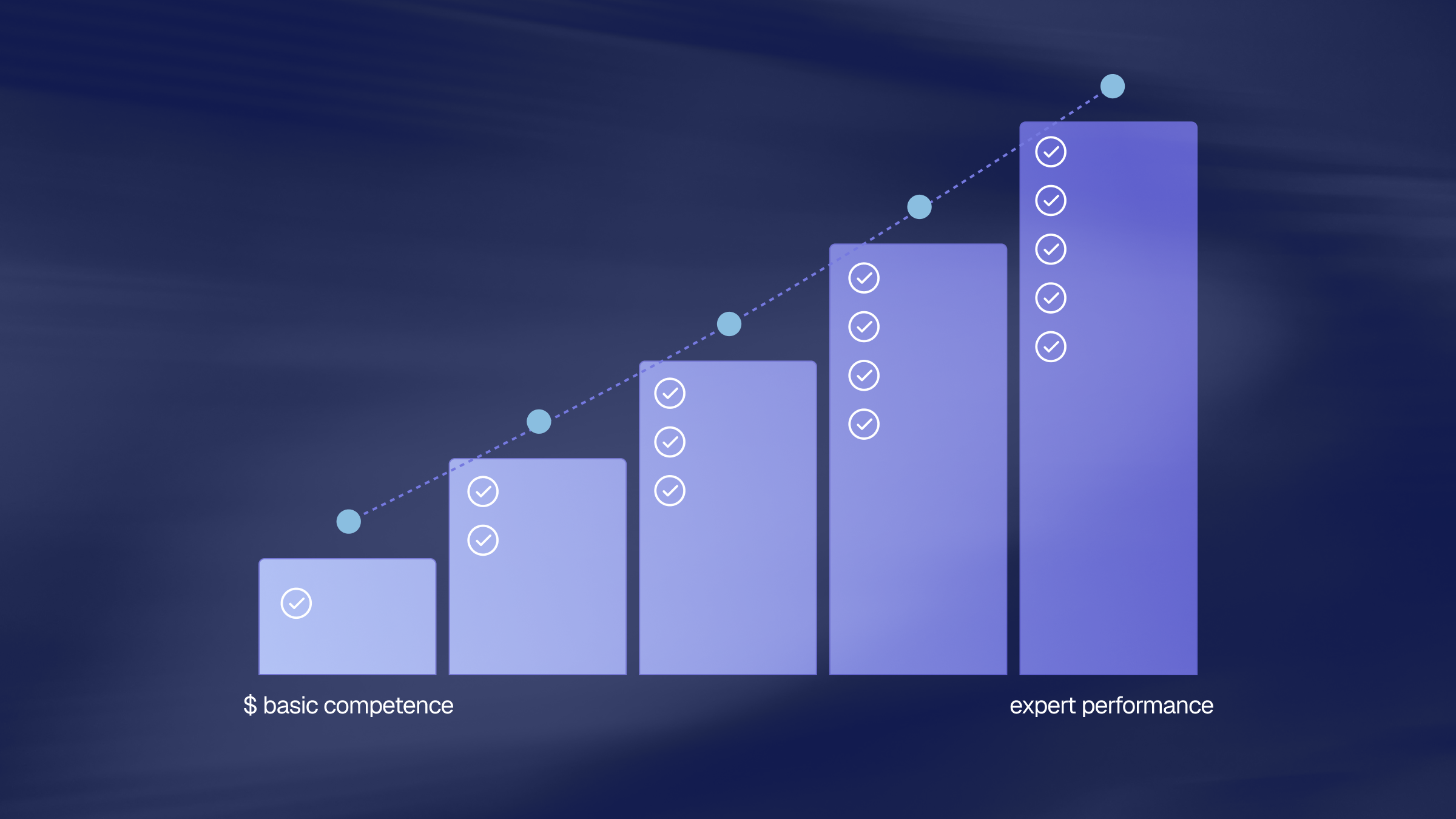
A student does not go from 1st to 12th grade in a single step. Each grade builds on a specific set of skills, and each one assumes the previous skills have already been mastered. Nobody learns calculus without algebra. When a student skips ahead anyway, what they end up with is memorization rather than understanding. The gaps show up later,
September 15, 2026
•
Snorkel Team
Terminal-Bench 4.0: Why Continuous Benchmarks Require Continuous QA
The speed of new frontier model releases keeps accelerating. Meanwhile benchmarks struggle to keep up and saturate quickly, often being left in the dust. Most benchmarks are static datasets with no active maintenance, causing them to lose value fast. Some benchmarks are looking to change this by becoming Continuous Benchmarks. Terminal-Bench is one of the most widely reported benchmarks on
August 27, 2026
•