

Snorkel AI CEO and co-founder Alex Ratner recently spoke with five researchers about the research they published finding creative new ways to get value out of foundation models. The researchers used prompting and weak supervision to build better, smaller models, explored how foundation models can be used to bolster programmatic labeling, and how an Ask Me Anything approach can bolster foundation model performance. They also looked probed how to sharpen and shrink GPT-3, and how contrastive learning boosts foundation model specialization.
These techniques can help organizations take greater advantage of foundation models, and could have important impacts on the field going forward.
Below follows videos from the interview series. You can click on any of the titles to see a transcript.
Prompting and weak supervision to build better models
Snorkel researcher Ryan Smith talks about his paper on using foundation models to build compact, deployable, and effective models. By asking multiple questions or prompts of the foundation model, it is possible to refine the output and use it to train smaller, specialist models. This allows organizations to take advantage of the benefits of foundation models while still being able to put governance constraints around them and reducing deployment costs.
How Foundation Models bolster programmatic labeling
Mayee Chen, a PhD student at Stanford, published a paper on the intersection of two promising data-centric AI techniques: foundation models and weak supervision. The paper demonstrates how combining these two techniques can improve the effectiveness of programmatic labeling. Chen explains that you can improve nuance in weak supervision by allowing the system to learn separate accuracy parameters for data subgroups. It also allows the system to project labels from labeled points onto unlabeled points that are close to it in the embedding space.
How a Brown professor sharpened and shrunk GPT-3
In this conversation, Alex and Brown professor Stephen Bach discuss Bach’s paper, “Multitask Prompted Training Enables Zero-Shot Task Generalization,” which was presented at ICLR this year. The paper explores how to improve prompting for zero-shot learning or zero-shot inference. Bach and his collaborators were able to create a model that was 16 times smaller than GPT-3, yet outperformed it on a number of benchmark tasks. The paper highlights the importance of data curation and multitask supervised training in building successful foundation models.
Contrastive Learning boosts Foundation Model specialization
Stanford PhD student Ananya Kumar discusses his paper “Connect, Not Collapse: Explaining Contrastive Learning for Unsupervised Domain Adaptation.” This paper focuses on how Foundation Models like BERT, GPT-3, and SimCLR can be pre-trained on a variety of data domains and still achieve state-of-the-art results when fine-tuned on a single domain. Ananya and Alex discussed the importance of having unlabeled data from the domain you care about, as well as the need for augmentations to create a connectivity between the domains. They also discussed the possibility of automatically optimizing augmentations to further improve performance.
Ask Me Anything approach bolsters foundation models
Stanford PhD student Simran Arora discusses her recent research on how prompting methods can enable a 6 billion parameter model to outperform a 175 billion parameter GPT-3 model. Their method, Ask Me Anything (AMA), applies multiple prompts to each example and aggregates the predictions using weak supervision. AMA has demonstrated significant boosts for 14 open-source language models, and has the potential to reduce the scalability challenges posed by large foundation models. They also discuss the importance of prompt engineering and the need for more principled approaches to fine-tuning and guiding these models.
Learn More
Follow Snorkel AI on LinkedIn, Twitter, and YouTube to be the first to see new posts and videos!


Matt Casey
Data Science Content Lead
Matt Casey leads content production at Snorkel AI. In prior roles, Matt built machine learning models and data pipelines as a data scientist. As a journalist, he produced written and audio content for outlets including The Boston Globe and NPR affiliates.
Recommended articles
View all articles
Grok 4.7 on Senior SWE-Bench: Strong pass@3, Cheaper Cost per Trial
Grok 4.7 was evaluated on Senior SWE-Bench, our benchmark for measuring whether coding agents work like senior engineers. It reaches a tasteful pass@3 of 40.0%, up from 38.9% for Grok 4.6, ranking sixth overall at $0.24 per trial, which is a fraction of the cost compared to Opus 4.8. Benchmark Senior SWE-Bench evaluates agents as compared to a senior engineer.
September 21, 2026
•
Snorkel Team
Data 2.0 and the research era of AI data
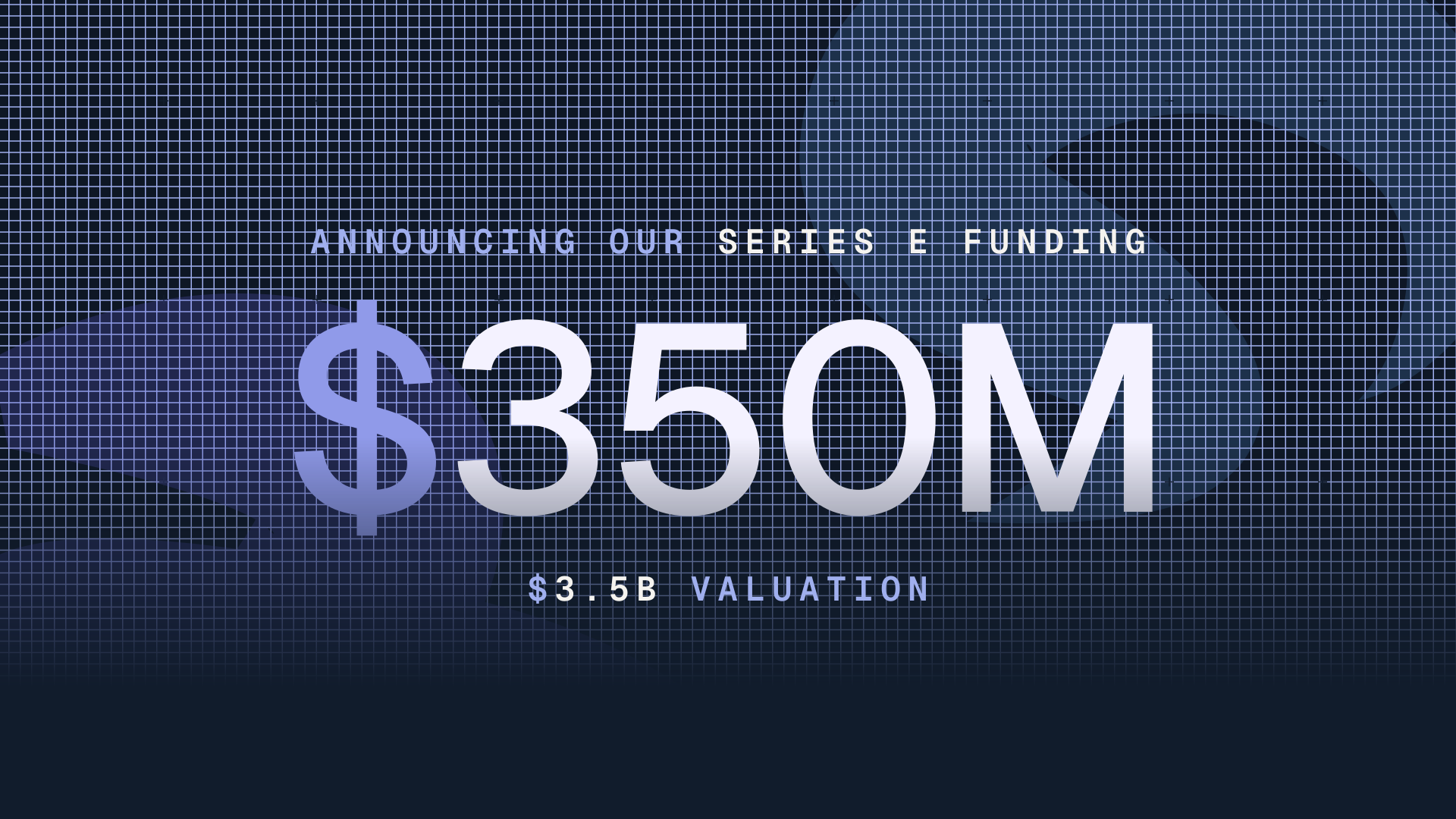
Today, I’m excited to announce Snorkel’s $350M Series E financing at a $3.5B valuation, led by Insight and S32, with participation from Third Point, March, Blumberg, Allegis, Standard VC, Frontline, and existing investors Addition, Lightspeed, Greylock, GV, P7, Wells Fargo, Walden Catalyst Ventures, and Factory.
September 20, 2026
•
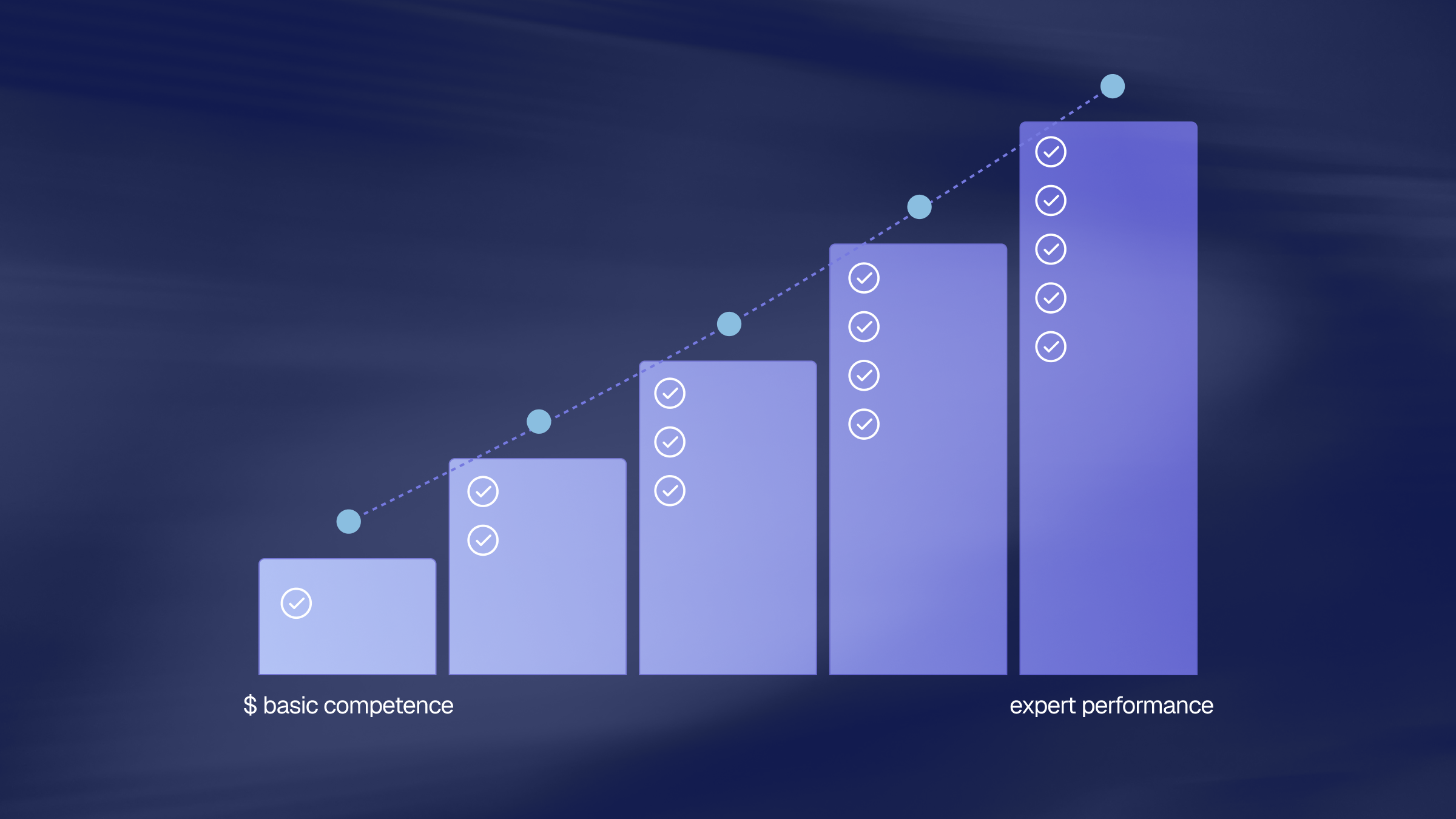
From Foundational Competency to Expert Performance: A Curriculum Approach to Model Development
A student does not go from 1st to 12th grade in a single step. Each grade builds on a specific set of skills, and each one assumes the previous skills have already been mastered. Nobody learns calculus without algebra. When a student skips ahead anyway, what they end up with is memorization rather than understanding. The gaps show up later,
September 15, 2026
•
Snorkel Team