

Most agent benchmarks still evaluate a thin slice of the job. The agent receives a task, produces an answer, gets scored, and the episode ends.
Enterprise workflows work differently. An underwriting agent may need to read policy documents, inspect customer records, call internal tools, ask a simulated user for missing information, update state, and follow approval rules.
A correct final sentence does not prove that the workflow was completed correctly.
Snorkel’s research team has been building these environments for domains such as insurance, finance, manufacturing, legal and sales and marketing. The work turns domain expert input into simulated companies with workflow systems that can support evaluation and reinforcement learning.
The central question is practical: how do you build a realistic enterprise environment that is solvable, difficult, and useful for training?
Enterprise environments give agents a place to learn
Enterprise agents need more than task prompts. They need a setting where actions have consequences.
An enterprise environment gives the agent that setting. It defines the tools the agent can call, the state those tools can change, the documents the agent can inspect, the users it can interact with, and the rules it has to follow, all within a simulated company.
A legal, healthcare, finance, or insurance agent can then be evaluated inside the workflow instead of only on the final answer.
The environment also creates the feedback signal. The agent acts. The environment changes. A judge scores the outcome. That score can be used for evaluation, and it can also support reinforcement learning by updating the policy that chooses future actions.
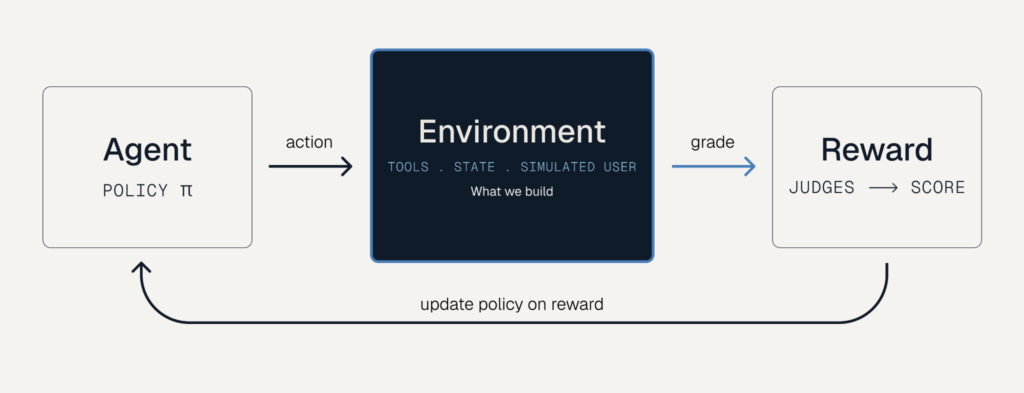
Figure: RL reward loop. The environment supplies the tools, state, and simulated user interaction that make agent behavior measurable. Judges convert the trajectory into a reward signal that can update the policy
For example, a model may know that a typical loan workflow allows approvals up to $10,000. A specific company may cap the same workflow at $1,000. The agent only gets the right outcome if it checks the environment instead of relying on the generic rule.
Public agent benchmarks test different parts of workflow behavior
Static benchmarks score a response against a reference answer. Agent environments expose the work around that response: tool calls, user turns, state changes, failed attempts, and final system state.
Tau-Bench shows that structure in customer service. The agent talks to a simulated user, chooses API tools, follows airline or retail policies, and tries to satisfy the user’s request.
The benchmark grades the final database state against the goal state. A seat-change task fails when the agent says the seat was changed but the database still shows the old seat.
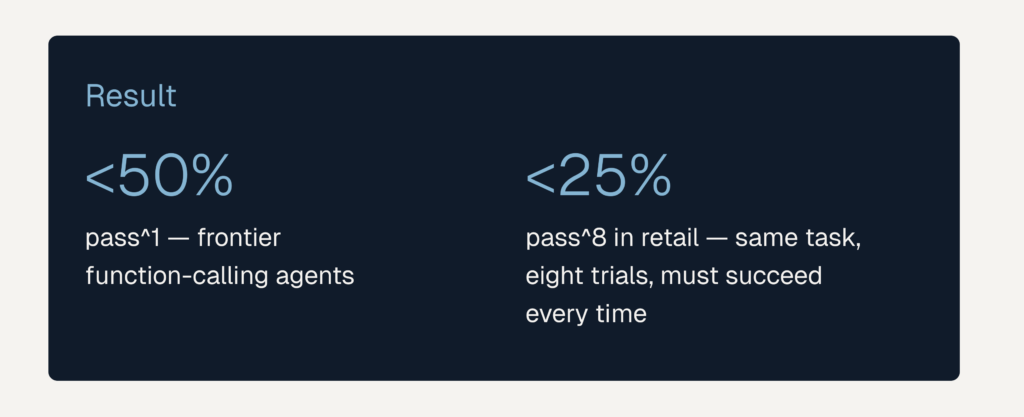
Tau-Bench also measures consistency. Pass^k runs the same task multiple times and checks whether the agent succeeds across trials.
Public environments show how to grade agent work: the agent acts, the environment changes, and the trajectory can be scored. Enterprise workflows make that setup harder because the agent needs information that public benchmarks and base LLMs do not contain.
| Benchmark | Environment | Workflow behavior it makes visible |
| Tau-Bench | Airline and retail customer-service workflows with API tools, policies, and simulated users | Tool choice, user interaction, rule following, repeated reliability, and final database state |
| TerminalBench | Terminal-based environments with command-line access and executable tests | File inspection, command execution, debugging, recovery, and verification through tests |
| OSWorld | Desktop and web application environments with GUI state and multimodal observations | Screen interpretation, GUI navigation, application state changes, and task completion |
Enterprise environments need domain-specific construction
Public benchmarks can reuse generic workflows and interfaces. Enterprise environments must instead reflect the systems, policies, data, and organizational boundaries of the business being modeled.
- The agent needs access to proprietary tools and APIs because the real work happens inside internal systems.
- Domain-specific policies define approval gates, compliance rules, and guardrails that can change the correct action.
- Internal and proprietary data supplies the thresholds, records, catalogs, and exceptions that may never appear in pretraining data.
- Real organizational structure determines permissions, access boundaries, and escalation paths.
These expert-defined details establish the environment’s boundary conditions: the tools, policies, data, permissions, and valid outcomes the generated environment must preserve and the agent must discover rather than infer from general domain knowledge.
Good environments balance solvability, realism, and difficulty
Enterprise environment design depends on a balance between three constraints.
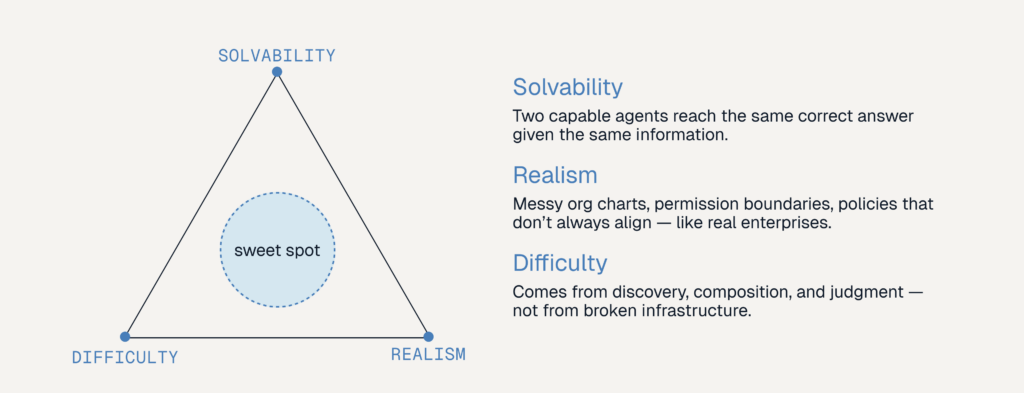
- Solvability: the environment should contain enough consistent evidence and available actions for capable agents to complete the workflow and reach a defensible outcome.
- Realism: the environment should preserve messy records, permission boundaries, policy conflicts, and user ambiguity.
- Difficulty: the task should require discovery, composition, and judgment rather than broken infrastructure or missing information.
Solvability under realistic conditions
A task is solvable when the environment contains a valid path through the workflow. The required evidence must be discoverable, and the available tools must support the actions needed to complete the task.
A successful oracle trajectory confirms that at least one valid path exists. Running the same task across capable agents provides a stronger test. Their intermediate decisions may differ, but they should reach the same defensible outcome from the available evidence.
Persistent disagreement can reveal missing records, contradictory policies, unavailable actions, or multiple valid interpretations. Those cases need expert review before the task can provide a reliable evaluation or training signal.
Solvability does not require removing enterprise complexity. Records can remain incomplete, policies can contain exceptions, and simulated users can omit or revise information. The task remains solvable when the necessary evidence can be recovered and the available actions support completion.
How Snorkel tests whether generated tasks are valid
Expert-authored seeds define what the environment should contain. The generated tasks still need to satisfy three conditions: the workflow must support a valid solution, the answer must require evidence from inside the environment, and evaluation must detect failures beyond the final response.
Oracle Agents Validate a Path Through the Workflow
Snorkel uses oracle agents to explore the completed environment and execute workflows defined in the seed files. The oracle can inspect documents, query database state, call available tools, and complete the workflow end to end.
A successful run confirms that the environment supports at least one valid trajectory. The captured outcome and state changes can then support task construction and evaluation without exposing privileged information in the task prompt.
The task can also be tested across frontier models. Their tool use may differ, but capable agents should converge on the same defensible outcome. Persistent disagreement can expose missing evidence, contradictory rules, unavailable actions, or multiple valid interpretations that require expert review.
Proprietary Rules Require Grounded Discovery
A solvable task can still provide weak training signal when the model can answer from pretraining without using the environment.
Snorkel introduces plausible company-specific rules, terminology, artifacts, and exceptions that are absent from public data. Domain experts keep these details consistent with the underlying workflow.
- Operational rules can introduce non-standard thresholds, approval gates, or regulatory interpretations. The correct action depends on the rule inside the environment rather than the industry default.
- Domain artifacts can include proprietary catalogs, internal terminology, organizational structures, and product names. The agent must inspect the available documents rather than rely on public terminology.
- Data characteristics can include noisy records, edge cases, null fields, and legacy policy behavior. These details force the agent to reason over the environment’s actual state.
The design test is whether an answer from memory diverges from one grounded in the environment. The agent should have to inspect evidence and apply the rule it finds.
Evaluation separates different failure modes
A final answer cannot reveal every workflow failure. An agent may provide the expected response while leaving the database in the wrong state, violating a permission boundary, or skipping a required approval.
Evaluation therefore needs to inspect several parts of the trajectory:
| Evaluation target | What it checks |
| Answer | Whether the agent produced the expected decision or information. |
| State | Whether the workflow, database, and documents reflect the expected result. |
| Safety | Whether the agent respected permissions, approval requirements, and prohibited actions. |
| Process | Whether the agent gathered the required evidence and followed an acceptable workflow. |
These checks can use deterministic validation, model-based review, or a combination appropriate to the workflow. The exact evaluation implementation can change without altering the underlying requirement: success must account for the outcome, resulting state, safety constraints, and trajectory.
A correct answer cannot compensate for an incorrect state or a safety violation. Process evaluation should still permit harmless variation when different tool sequences satisfy the same evidence and workflow requirements.
Insurance Underwriting shows the full workflow system
Snorkel’s insurance-underwriting environment provides a concrete test of whether expert-defined constraints can produce solvable, stateful tasks and useful training signals.
The environment contains more than 50 database tables, 100 connected documents, 47 workflow tools, 2,000 generated tasks, and seven user personas. These components create dependencies across records, policies, tool access, user interaction, and workflow state.
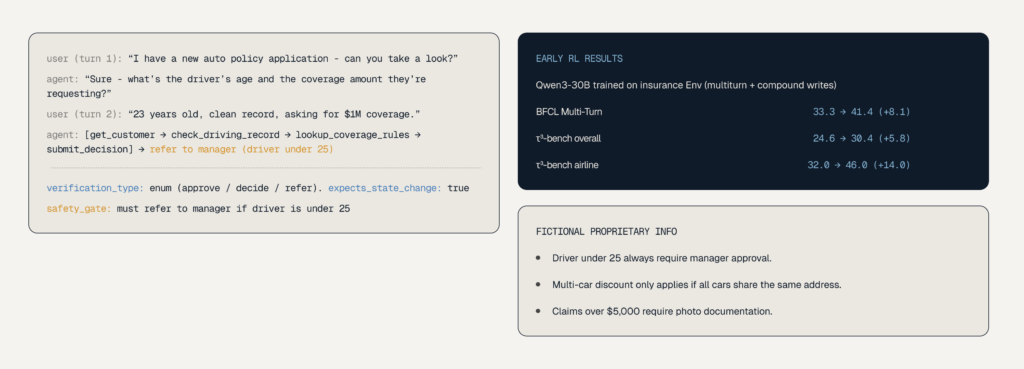
The sample task is a new auto policy application. The user gives the agent a driver profile and coverage request. The agent has to ask for missing information, check the customer record, inspect the driving record, look up coverage rules, and submit a decision.
The proprietary rule changes the outcome. In this environment, drivers under 25 require manager approval. The correct action is to refer to the manager, even when the driver has a clean record.
The task is graded on the underwriting decision, resulting workflow state, compliance with the under-25 referral rule, and whether the agent gathered the required evidence using appropriate tools.
Early training results show that the environment produced useful workflow signal. A Qwen3-30B model trained on the insurance environment improved on multi-turn and tool-use evaluations:
- BFCL Multi-Turn: 33.3 → 41.4, a gain of 8.1 points.
- τ³-bench overall: 24.6 → 30.4, a gain of 5.8 points.
- τ³-bench airline: 32.0 → 46.0, a gain of 14.0 points.
The gains suggest that training on one enterprise environment can teach behavior that transfers beyond the original domain: asking for missing information, using tools, applying hidden rules, and maintaining state across a workflow.
Open questions for enterprise environments
Static evaluations can show whether a model produced an acceptable answer. They cannot show whether an agent gathered the right evidence, used permitted actions, maintained state, or recovered from ambiguity during a workflow.
- LLM judge reliability: semantic, safety, and process judges can grade behavior that exact checks miss, but their calibration and consistency matter when those judgments become reward signals.
- Adaptive difficulty: environments need tasks that stay challenging as agents improve. The harder problem is preserving difficulty without constantly re-authoring the environment.
- Process vs. outcome reward: final state is easier to verify, but workflow quality often depends on the path. Reward design has to decide how much weight to give tool choice, reasoning quality, and user interaction.
Trajectory-graded environments make these behaviors observable. They provide a stronger basis for studying whether agents can complete stateful, domain-specific workflows under realistic constraints, and for turning those observations into training signals.
Acknowledgments
Enterprise environment-building is a cross-functional effort. This work reflects contributions from Snorkel’s Forward Deployed Engineering, Technical Delivery Management, Research, and Delivery Operations teams.
Contributors include Joe Licata, Peter Marinov, Jeremy Chan, Aleem Lakdawala, Vrushank Kumar, Pedro Alves, Marwan Bounassif, Connor Young, Chris Glaze, Bhavishya Pohani, Ramya Ramakrishnan, Maria Mir, Jon Kovar, and Louisa Savageaux.


Chris Glaze
Principal Research Scientist
Experienced PhD with a demonstrated history of developing novel machine learning tools and mathematical models in academia and industry. Accomplishments span data mining, experimental research, and application to digital technologies.

Joe Licata
Senior Forward Deployed Engineer
Joe Licata is a Senior Forward Deployed Engineer at Snorkel AI with a PhD in Aerospace Engineering. His recent experience with Snorkel is focused on developing agentic coding RL environments. Prior to transitioning to the LLM data space, he researched machine learning for upper-atmospheric modeling to improve satellite trajectory prediction.
Recommended articles
View all articles
Grok 4.7 on Senior SWE-Bench: Strong pass@3, Cheaper Cost per Trial
Grok 4.7 was evaluated on Senior SWE-Bench, our benchmark for measuring whether coding agents work like senior engineers. It reaches a tasteful pass@3 of 40.0%, up from 38.9% for Grok 4.6, ranking sixth overall at $0.24 per trial, which is a fraction of the cost compared to Opus 4.8. Benchmark Senior SWE-Bench evaluates agents as compared to a senior engineer.
September 21, 2026
•
Snorkel Team

Data 2.0 and the research era of AI data
Today, I’m excited to announce Snorkel’s $350M Series E financing at a $3.5B valuation, led by Insight and S32, with participation from Third Point, March, Blumberg, Allegis, Standard VC, Frontline, and existing investors Addition, Lightspeed, Greylock, GV, P7, Wells Fargo, Walden Catalyst Ventures, and Factory.
September 20, 2026
•
From Foundational Competency to Expert Performance: A Curriculum Approach to Model Development
A student does not go from 1st to 12th grade in a single step. Each grade builds on a specific set of skills, and each one assumes the previous skills have already been mastered. Nobody learns calculus without algebra. When a student skips ahead anyway, what they end up with is memorization rather than understanding. The gaps show up later,
September 15, 2026
•
Snorkel Team