

Meta released Llama 3.1 today signaling a new era of open source AI. The Llama 3.1 models include 8b, 70B, LlamaGuard, and the new Llama 3.1 405B, the largest open source foundation model with over 400 billion parameters. Llama 3.1 performance will rival OpenAI’s GPT-4 model, despite using less than half the parameters.
This is an important milestone for the AI development stack. For AI to flourish in the enterprise, businesses need to have choices. Enterprises want to adopt foundation models that best fit their use case and then specialize those models to achieve production quality performance against domain and business-specific criteria.

With Meta’s release of open source foundation models that match the performance of proprietary models at a lower cost, the market benefits from more options to build custom AI applications.
Day 1 availability: Llama 3.1 models available in Snorkel today
As of today, all Meta Llama 3.1 large language models are natively available as part of the Prompt Builder in Snorkel Flow:

Here’s a quick demo of how easy it is to activate Meta Llama 405B in Snorkel Flow. AI development teams can access Meta’s industry-leading Llama 3.1 models from their service of choice using Hugging Face, Together AI, Microsoft Azure ML, AWS SageMaker, and Google Vertex AI Model Garden.

The growing importance of OSS in the enterprise
With the launch of Llama 3.1 Meta has not been shy about its stance that AI will be driven by open source. Mark Zuckerberg authored a blog today, Open Source AI Is the Path Forward, that outlines the parallels between early proprietary AI model development and early proprietary OS software development. He forecasts that closed, proprietary AI models will be replaced by open source models just as Unix was replaced by Linux as the dominant OS.
The reason for that is that, especially when it comes to infrastructure, developers and enterprises benefit from having more adaptable, affordable, and better foundations from which to build. Beyond the OS we have seen this play out in databases with the rise of MySQL and later MongoDB, as well as with key technologies that accelerated cloud adoption like Kafka and K8s.
We agree that open source models are likely to gain widespread enterprise adoption. This provides enterprises more flexibility in model size, data controls, and location, as well as affordability. The Llama 3.1 release shows that very soon open source models will also provide best-in-class performance.
Paired with Snorkel Flow’s data development capabilities, the LLama 3.1 model family will help enterprises cross the chasm from prototype to production:
- LLM specialization via fine-tuning/alignment – With Snorkel Flow, enterprises can leverage a powerful combination of Llama 3.1 outputs with their own domain expertise to create fine-tuning datasets more quickly than ever.
- SLM for real, practical use cases – The Wall Street Journal recently covered this trend, noting: “This category of AI software—called small or medium language models—is trained on less data and often designed for specific tasks.” Llama 3.1 can now be used to build SLMs via synthetic data & distillation approaches in Snorkel Flow.
- LLM evals – Snorkel allows teams to combine powerful evaluators like Llama Guard 3 safety model with your own guardrails & acceptance criteria.
Meta’s continued leadership in open source model development is a critical step towards more efficient, lower cost AI systems that incorporate a variety of models and route queries based on best fit. The pattern here is not far off from the use of micro-service where orchestration enables a far more efficient use of compute resources with better outcomes. Fortunately, most of the major inference providers have also announced that they are supporting Llama 3.1 which means most enterprises are in a good position to quickly adopt the Llama models.
We believe Meta’s release today was a push towards flexibility—flexibility to choose the best foundation model for your task and specialize from there. The Llama 3.1 models provide another great option for our customers as they look for the right foundation model. We encourage enterprises to seriously consider the new Meta offerings.
Ready to accelerate AI development?
Deploy production AI and ML applications 10-100x faster with Snorkel’s experts, using our proprietary technology.

Cate Lochead
Chief Marketing Officer
Cate Lochead is the Chief Marketing Officer at Snorkel AI. With over 25 years of experience at companies like Oracle, Couchbase, and Intuit, Cate brings deep expertise in building high-growth marketing organizations. Prior to joining Snorkel AI, she served as CMO at JumpCloud, where she built a global marketing team that fueled three years of hyper-growth and helped secure over $300 million in VC funding. As SVP of Marketing at Carbon Black, Cate led product and corporate marketing through the company’s highly successful IPO. Her expertise spans enterprise sales, open-source, and product-led growth strategies, particularly targeting technical buyers.
Recommended articles
View all articles
Grok 4.7 on Senior SWE-Bench: Strong pass@3, Cheaper Cost per Trial
Grok 4.7 was evaluated on Senior SWE-Bench, our benchmark for measuring whether coding agents work like senior engineers. It reaches a tasteful pass@3 of 40.0%, up from 38.9% for Grok 4.6, ranking sixth overall at $0.24 per trial, which is a fraction of the cost compared to Opus 4.8. Benchmark Senior SWE-Bench evaluates agents as compared to a senior engineer.
September 21, 2026
•
Snorkel Team
Data 2.0 and the research era of AI data
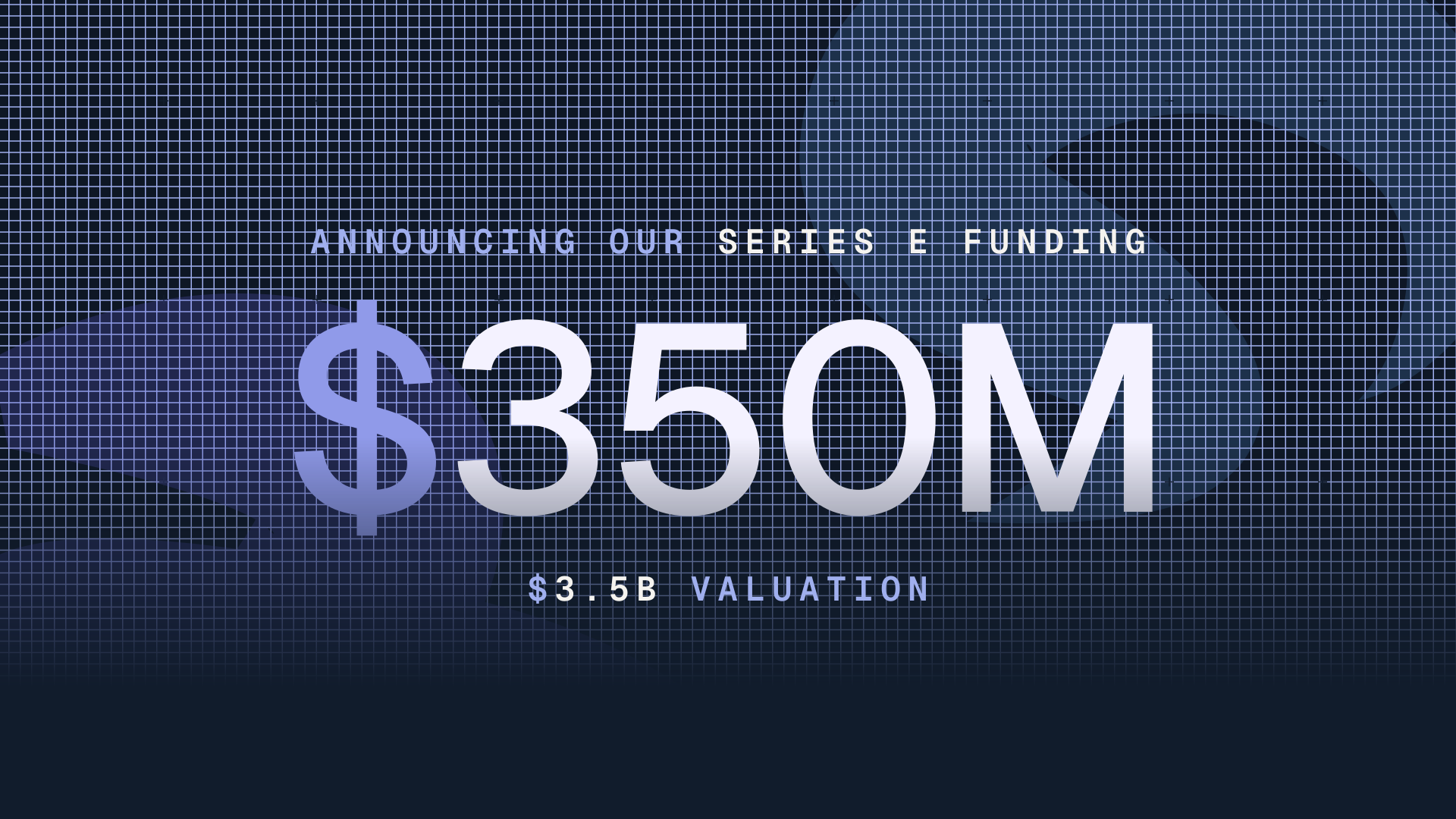
Today, I’m excited to announce Snorkel’s $350M Series E financing at a $3.5B valuation, led by Insight and S32, with participation from Third Point, March, Blumberg, Allegis, Standard VC, Frontline, and existing investors Addition, Lightspeed, Greylock, GV, P7, Wells Fargo, Walden Catalyst Ventures, and Factory.
September 20, 2026
•
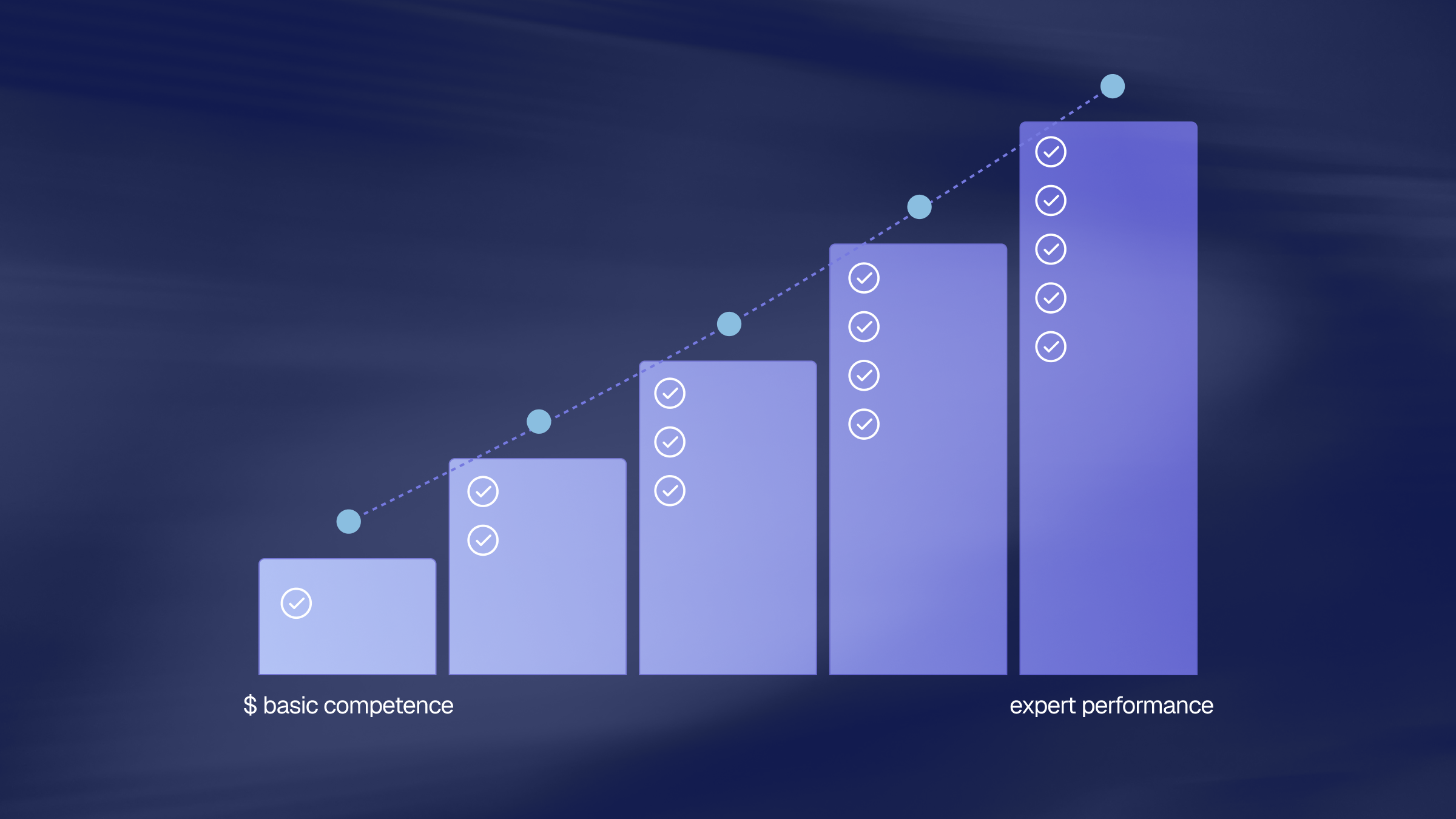
From Foundational Competency to Expert Performance: A Curriculum Approach to Model Development
A student does not go from 1st to 12th grade in a single step. Each grade builds on a specific set of skills, and each one assumes the previous skills have already been mastered. Nobody learns calculus without algebra. When a student skips ahead anyway, what they end up with is memorization rather than understanding. The gaps show up later,
September 15, 2026
•
Snorkel Team