

Banks leverage email surveillance as a critical tool to combat fraud. First used in 1996 to detect fraudulent wire transfers, email surveillance helps banks thwart phishing attacks, detect money laundering, and protect customer data.
Banks also commonly surveil emails to:
- Identify potential insider threats.
- Investigate suspicious activity.
- Comply with regulations.
While banks and financial institutions have used email monitoring for nearly two decades, modern artificial intelligence (AI) tools and workflows can build better monitoring utilities, faster.
The early days of email monitoring
Traditionally, banks have used methods like rule-based filtering to monitor emails for potential threats. These rules identified elements in emails (i.e. subject lines, attachment types, keywords) that might indicate fraud or phishing. Banks also engage in user behavior analysis to identify suspicious patterns that indicate potential bad actors, such as sending large numbers of emails to different people in a short period.
However, these methods have limitations. They can be easily bypassed by criminals, are difficult to encode, are highly labor-intensive, and challenging to scale.
AI-accelerated email monitoring
In recent years, many banks have adopted AI to monitor emails for fraud detection and phishing. AI can help identify patterns of suspicious activity, prioritize alerts, and automate portions of the investigation process.
AI techniques used to monitor emails for fraud detection and phishing include:
- Natural language processing (NLP) to identify keywords, phrases, and other patterns that are associated with fraudulent behavior.
- Anomaly detection to understand what a range of normal email activity looks like and flag when an email diverges from that range.
- Deep learning to learn complex patterns from data that are difficult to identify using traditional methods.
While AI can significantly improve and speed up email surveillance efforts, many banks struggle to build sufficient datasets to train models. Raw data is often noisy, incomplete, and requires significant human intervention to be useful. Without high-quality training sets, production AI applications can generate more incorrect results and waste resources.

How Snorkel AI builds better AI for email monitoring
Snorkel AI offers a data-centric AI platform that helps businesses build and deploy AI applications quickly and efficiently. Snorkel enables increased accuracy, scalability, and security with:
- Labeling functions and weak supervision. Labeling functions and weak supervision let users create large training sets quickly and programmatically, allowing labeling schemas and labeling logic to shift with business needs.
- Cross-team collaboration. Data scientists and subject matter experts collaborate to encode hard-earned intuition into labeling functions; weak supervision quickly determines which labeling function is most likely to be right in each case.
- Model explainability. Snorkel equips users with artifacts that allow them to understand how and why their model got a prediction wrong. It also allows users to quickly add or adjust labeling functions to address current model shortfalls.
When banks build models and applications with Snorkel, they can quickly deploy in their secure environments thanks to our partnerships with Google Cloud, Microsoft Azure, and others. In addition, they can feel confident their data is secure should the preferred deployment be in Snorkel Cloud, due to its enterprise-grade security and SOC2 Type 2 certification.
Data scientists, machine learning engineers, and subject matter experts using Snorkel can build, refine and iterate on their labeling functions until they reach the level of performance their business needs. The platform even enables users to fuel their iterative loop with the power of foundation models.
Foundation models are fueling the future of email monitoring
The recent emergence of foundation models (FMs) has amplified AI’s ability to accomplish many tasks, including email surveillance.
While banks likely wouldn’t want to rely directly on generative, multi-billion parameter large language models (LLMs) like GPT-4 or LLama 2 to monitor individual emails as they’re often too expensive on a per-use basis, Snorkel Flow enables users to harness their power to effectively and efficiently to solve the specific use case at hand.
Banks can also use best-in-breed foundation models (closed-API & open source) to boost their AI efforts by:
- Labeling training data at a greater scale. While you can directly ask an LLM if an email is likely to be fraudulent or phishing, the better practice would be to ask more specific questions. For example: does this email ask for private data? Data scientists can combine the results of these questions through an approach like weak supervision. The Snorkel Flow platform can even suggest potentially-useful labeling functions automatically.
- Training and distilling. Financial institutions can fine-tune a large model like Llama 2 to expertly spot fraud and phishing. Then, they can distill that model’s expertise into a deployable form by having it “teach” a smaller model like BERT.
Publicly available FM/LLM API’s can be a non-starter for banks due to regulations around sending sensitive data to third-parties. However, Snorkel banking customers are still able to leverage this powerful technology to expedite model development and application development thanks to the robust native integrations in Snorkel Flow.
Build better email monitoring faster with Snorkel AI
While the use of AI in email surveillance is still evolving, it has already revolutionized how banks detect and prevent fraud. Traditional methods like rule-based filtering have limitations. Artificial intelligence-based techniques such as NLP and anomaly detection can enable faster and more effective monitoring.
Foundation models can enhance email monitoring applications by aiding in labeling training data at scale and generating synthetic data for more robust surveillance models.
Banks can build these models quickly and efficiently on Snorkel AI’s data-centric AI platform. Our programmatic weak supervision tools enhance accuracy and model delivery speed. The platform’s trail of artifacts also enhances accountability, and our security practices allow banks to handle their sensitive data safely.
Are you ready to enhance your email surveillance with AI and protect your institution against fraud? Contact us today to learn more and get started.
Ready to accelerate AI development?
Deploy production AI and ML applications 10-100x faster with Snorkel’s experts, using our proprietary technology.

Recommended articles
View all articles

Grok 4.7 on Senior SWE-Bench: Strong pass@3, Cheaper Cost per Trial
Grok 4.7 was evaluated on Senior SWE-Bench, our benchmark for measuring whether coding agents work like senior engineers. It reaches a tasteful pass@3 of 40.0%, up from 38.9% for Grok 4.6, ranking sixth overall at $0.24 per trial, which is a fraction of the cost compared to Opus 4.8. Benchmark Senior SWE-Bench evaluates agents as compared to a senior engineer.
September 21, 2026
•
Snorkel Team
Data 2.0 and the research era of AI data
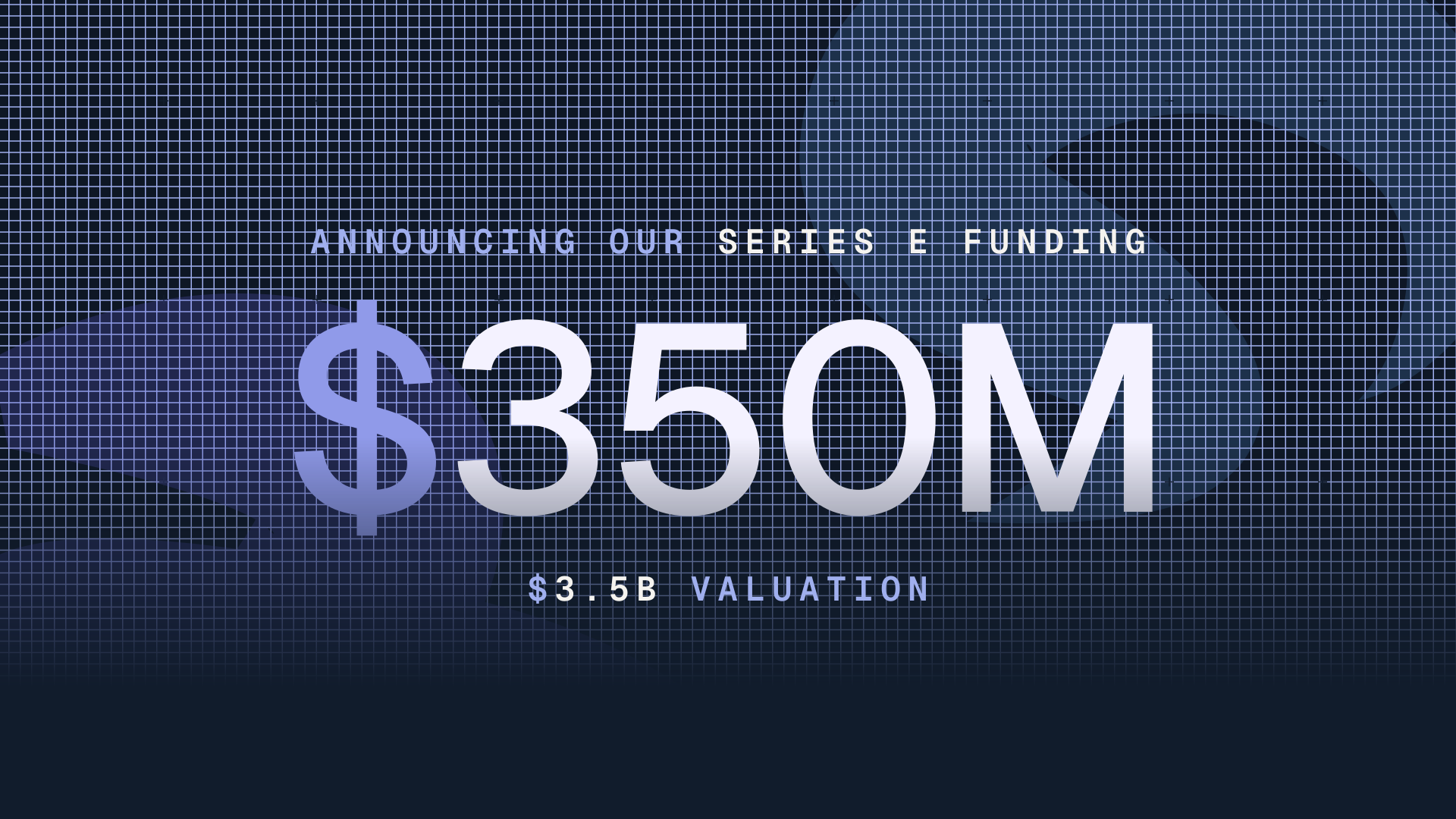
Today, I’m excited to announce Snorkel’s $350M Series E financing at a $3.5B valuation, led by Insight and S32, with participation from Third Point, March, Blumberg, Allegis, Standard VC, Frontline, and existing investors Addition, Lightspeed, Greylock, GV, P7, Wells Fargo, Walden Catalyst Ventures, and Factory.
September 20, 2026
•
From Foundational Competency to Expert Performance: A Curriculum Approach to Model Development
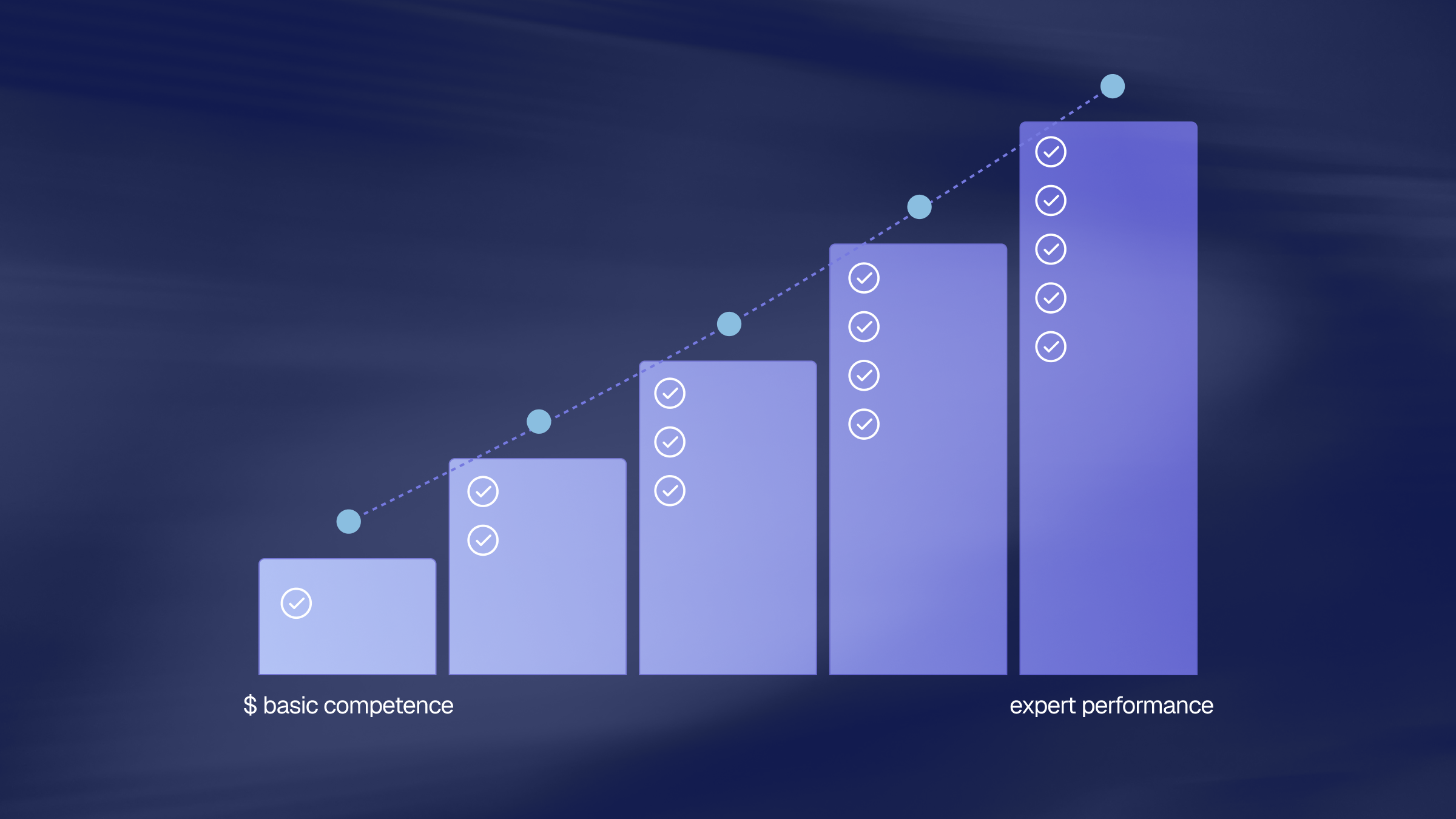
A student does not go from 1st to 12th grade in a single step. Each grade builds on a specific set of skills, and each one assumes the previous skills have already been mastered. Nobody learns calculus without algebra. When a student skips ahead anyway, what they end up with is memorization rather than understanding. The gaps show up later,
September 15, 2026
•
Snorkel Team